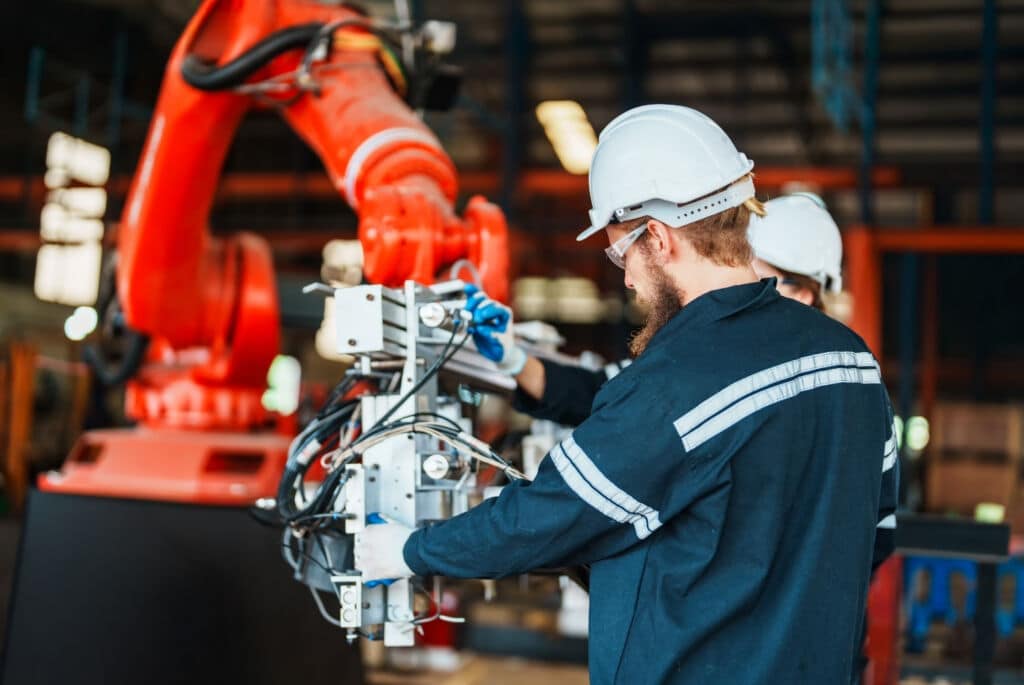
Automation and advanced manufacturing (or smart manufacturing) are becoming normal parts of modern manufacturing. Manufacturers are using them to improve quality, reduce downtime, increase throughput, and stay competitive as customer expectations rise.
But implementation carries risks. A new automation system can disrupt production if the workforce isn’t ready to install it, support it, troubleshoot it, document it, and stabilize it.
Contract staffing offers manufacturers a better solution for their staffing strategy during these transitions. During an automation transition, you may need temporary access to specialized skills before you know whether those roles should become permanent. You may also need a trial period for new automation-related roles, especially when the work is evolving and the long-term skill mix isn’t fully clear.
Table of Contents
How Smart Manufacturing Changes the Talent Acquisition Strategy
Smart manufacturing doesn’t simply reduce labor needs. It changes the type of work people perform, the skills they need, and the way production teams interact with technology. NIST describes Industry 4.0 as the use of technologies such as robotics, the Internet of Things, big data analytics, artificial intelligence, and autonomous systems to automate traditional manufacturing processes. Those technologies can improve capability and efficiency, but only when the workforce can support them.
The change shows up in various places across the plant. Operators may need to work with HMIs, sensors, digital instructions, and exception-based production workflows. Maintenance teams may need stronger electrical, PLC, robotics, controls, and diagnostic skills. Quality teams may need to interpret real-time process data instead of relying only on manual inspection points. Engineers may need to support equipment integration, process optimization, and documentation while production continues.
The World Economic Forum projects that by 2030, nearly 40% of the core skills of the advanced manufacturing and supply chain workforce will change. For manufacturers, this is a warning. If the required skill mix is expected to keep changing over the next several years, you need a staffing model that lets you access skills temporarily, adjust as needs evolve, and avoid long hiring processes and permanent hires until you know they’re necessary.
This flexibility is especially important when the roles being created today are still taking shape and evolving with new technologies. You may know you need automation support, but you may not yet know whether the best long-term answer is a full-time automation technician, controls engineer, manufacturing engineer, maintenance specialist, quality systems technician, or IT/OT support role.
Whether you know what you need for the role or not, the work still needs to be done in the meantime. Contract staffing allows you to find someone who can handle the work while the real demands of the role start to define themselves.
Avoiding Business Disruptions During the Transition to Automation/Advanced Manufacturing
Manufacturers rarely get to pause normal operations while new systems are installed. You still have to meet production schedules, maintain existing equipment, support operators, hit customer deadlines, protect safety, and manage quality. At the same time, your internal team may be asked to support vendors, debug equipment, rewrite procedures, train workers, validate processes, and stabilize new workflows.
That’s where the risk builds during transitions. The problem isn’t always the technology. Often, the strain comes from asking the same internal team to run the existing operation and absorb the implementation workload at the same time.
Many manufacturers are working through talent acquisition challenges, complex transformation efforts, and operational risk as factories and operations become smarter. In Deloitte’s 2025 smart manufacturing research, 65% of respondents ranked operational risk as a first or second priority requiring mitigation in smart manufacturing initiatives.
Contract staffing becomes valuable when you use it to reduce the execution strain. The goal isn’t to replace the permanent team or outsource ownership of the transition. The goal is to give your internal team enough support to keep daily operations stable while the business moves through the implementation period.
That support can include temporary access to controls technicians, automation specialists, maintenance backfill, quality technicians, manufacturing engineers, process engineers, documentation support, project coordinators, or IT/OT professionals. For manufacturers moving through automation projects, manufacturing contract staffing can help cover the gap between current workforce capacity and the skills needed during the transition.
The Advanced Manufacturing Transition Staffing Model
A smoother automation transition starts by separating the workforce into stages. You don’t need every skill forever and you don’t need every role at the same intensity throughout the project. Contract staffing is most useful when you match the staffing model to the stage of the transition.
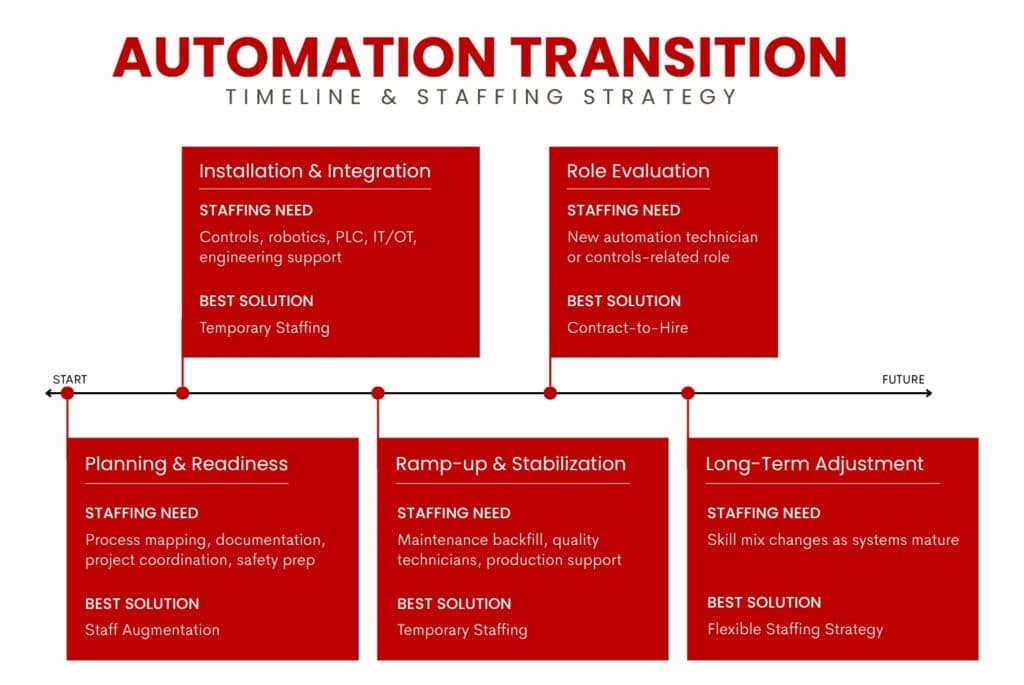
Planning & Readiness Support
Before implementation, you may need help preparing the operation for change. That could include project coordination, process mapping, documentation, engineering workload support, safety preparation, data readiness, or role planning. In many cases, your internal team understands the plant well enough to lead the work, but they may not have enough bandwidth to do it on top of daily responsibilities.
Staff augmentation often works well during this stage because it lets you temporarily add external professionals to your existing team while you continue directing the work. In this staffing model, external professionals work under your direction, using your tools and processes, without requiring permanent hires.
That structure works well when you have internal ownership but need extra capacity. You’re not handing off the strategy. You’re giving your team more room to execute it.
Installation & Integration Support
During installation and integration, the skill needs often become more specialized. You may need automation technicians, robotics technicians, PLC programmers, controls technicians, electrical technicians, manufacturing engineers, process engineers, project coordinators, or IT/OT support specialists.
Some of those needs may be temporary. You may need heavy controls or integration support during startup, but not at the same level once the system stabilizes. You may need documentation support during validation, but not as a permanent function. You may need IT support during system connection, cybersecurity review, or data setup, but not enough to justify a full-time role on that site.
In these situations, contract staffing can give you access to the skill set without forcing a permanent hire for a role that may not be needed later on. For more specialized technical work, engineering contract staffing may fit when speed, specialization, or flexibility matter more than permanence.
Smart manufacturing can also create IT & technology staffing needs that sit between operations and IT. Connected equipment, cloud systems, cybersecurity, ERP integrations, and production data tools may require temporary support from technology professionals.
Ramp-Up & Stabilization Coverage
When these initiatives are finally launched, the workforce strain often becomes more visible. New equipment may run, but the process may not be stable yet. Operators may still be learning the workflow. Maintenance may be troubleshooting early failures. Quality may be watching for new sources of variation. Supervisors may be managing schedule changes, training needs, and production pressure at the same time.
Temporary staffing can help protect your operation during that period. You may need maintenance coverage while your senior technicians support the rollout. You may need temporary production coverage while operators move through a learning curve. You may need quality technicians during validation or process changes. You may need shift supervision support when schedules are disrupted.
The real value of temporary staffing is the ability to adjust your workload capacity as needed. This way, you’re not asking the same group of people to operate, troubleshoot, train, document, and stabilize everything at once.
Contract-to-Hire for New Automation-Related Roles
Some automation-related roles are hard to define until the new systems are up and running.
Contract-to-hire can help when you expect a role to become permanent but want real-world evidence before making that commitment. In a contract-to-hire model, the employee starts working on a contract basis and can convert to permanent employment if the fit is right. It gives you a practical evaluation period for roles where skill, pace, and team fit matter.
This evaluation period is especially useful in automation transitions. If nearly 40% of core skills in advanced manufacturing and supply chain work are expected to change by 2030, you need room to evaluate the role and the skills needed for it. As technology and systems change, the skills needed for the job may change as well.
Having a trial period allows you to test both the role and the employee working it. With new technology being implemented, you may not know the exact skills and responsibilities that should be assigned to it. This period gives you a chance to test the role to see if it’s having the impact you need it to have within the company. If it’s not working, you have the flexibility to adjust the role and look for a new candidate that may be a better fit. If the role is already well defined and implemented in the processes, this period still gives you the chance to make sure the hire you make is right for the role before bringing them onto the team permanently.
Long-Term Workforce Adjustment
Automation maturity does not stop after installation. Your staffing needs may change again as systems improve, production volumes shift, data quality improves, and internal employees gain new skills.
A plant may start with integration support, then need ramp-up coverage, then need a contract-to-hire automation technician, then need temporary engineering help for the next phase. Contract staffing gives you more room to adjust the skill mix as the system matures.
That flexibility is not a substitute for long-term workforce planning. It’s a way to avoid overcommitting while the long-term operating model is still becoming clear.
Which Roles Are Most Likely to Change During Automation Implementation
Automation affects different roles in different ways. The most obvious changes may involve robotics or controls, but the workforce impact is broader than that.
Maintenance & Reliability Roles
Maintenance work becomes tied closer to uptime, diagnostics, and system stability. Technicians may need stronger knowledge of electrical systems, sensors, drives, HMIs, PLCs, robotics, preventive maintenance, and connected equipment. The shift is from reactive repair toward faster diagnosis, better escalation, and deeper understanding of how automated systems behave in production.
Production & Operator Roles
Automation changes operator work by moving more attention toward monitoring, exception handling, digital instructions, basic troubleshooting, and quality checks. Operators may spend less time performing repetitive manual tasks and more time identifying when the process is drifting, when equipment needs support, or when a problem should be escalated.
Quality & Process Roles
Smart manufacturing can create more process data, but data only helps when someone can interpret it. Quality and process teams may need stronger skills around validation, traceability, inspection logic, digital documentation, and production analytics. If automated systems change how variation appears, quality teams need to understand the process well enough to separate normal adjustment from true risk.
Engineering, Controls, & IT/OT Roles
Smart manufacturing often brings engineering, operations, and technology teams closer together. Equipment may connect to data platforms. Production systems may require cybersecurity review. ERP, MES, maintenance, and quality systems may need to exchange information. That creates demand for people who understand both technical systems and plant realities.
This cross-functional pressure is one reason permanent hiring can be difficult during implementation. The need may be real, but it may not fit neatly into one traditional job title yet.
How to Choose the Right Contract Staffing Model
Different contract staffing models solve different problems. Treating them as interchangeable can create confusion around budget, supervision, accountability, and timing.
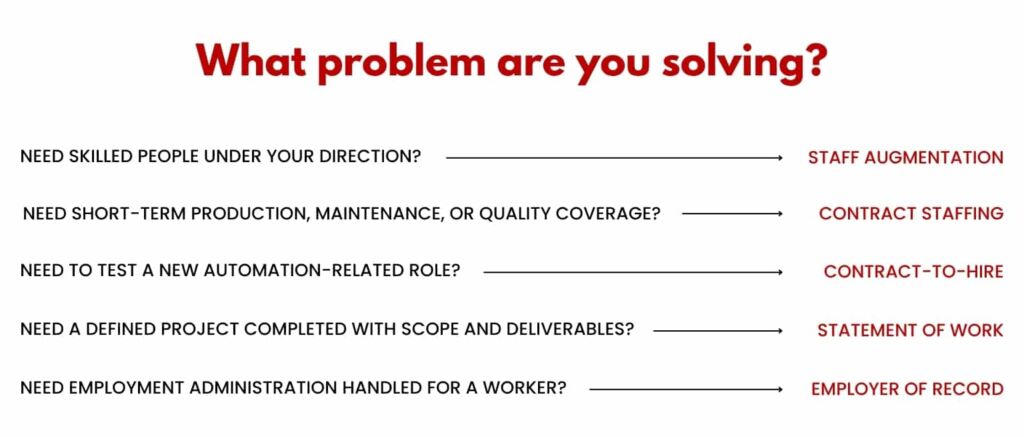
| Staffing Needs | Best Model | Why it Fits |
| Add skilled people under your direction | Staff augmentation | You keep control of the work while adding temporary capacity. |
| Cover short-term production, maintenance, or quality gaps | Contract staffing services | You can bring in temporary workers, short-term project staff, or contract employees based on the need. |
| Evaluate a new automation-related role before permanent hiring | Contract-to-hire | You get a real-world trial period before making a long-term commitment. |
| Complete a defined implementation, documentation, or support project | Statement of Work | The model is tied to scope, deliverables, timing, and accountability. |
| Bring in workers while reducing employment-administration burden | Employer of Record | The EOR legally employs the worker while you direct day-to-day work. |
For help figuring out the model that fits your needs best, reach out to our team to discuss the staffing issues you’re facing or take a look at our staffing model comparison guide to learn more.
Building a Smoother Transition Plan Before Automation Goes Live
Before you implement new automation or smart manufacturing systems, separate your staffing needs by their timing and purpose.
Ask:
- Which skills do you need only during implementation?
- Which skills may become permanent requirements?
- Which current employees will be pulled into the rollout?
- Where will you need backfill to protect production?
- Which roles are uncertain enough to test through contract-to-hire?
- Which project needs are better handled through an SOW model?
- Which employment logistics could slow down urgent staffing?
Those questions help you avoid two common problems: understaffing the transition or overcommitting to permanent roles before the need is proven. The strongest approach is to protect your core workforce, bring in specialized help where the transition demands it, and keep enough flexibility to adjust as the technology matures.
Contract Staffing Gives Manufacturers Room to Adapt as Automation Evolves
Advanced manufacturing and automation can improve performance, but the transition creates real workforce pressure. Skills change. Roles evolve. Internal teams get stretched. New systems need support before the permanent staffing model is obvious.
Contract staffing gives you room to manage that uncertainty. You can access specialized skills temporarily, protect production while internal teams adapt, evaluate new roles before converting them to permanent positions, and adjust staffing as the needs of the operation change.
For manufacturers moving through automation projects, PeopleSolutions can support flexible workforce needs through manufacturing contract staffing including staff augmentation, contract-to-hire, SOW staffing, and employer-of-record solutions.
If you’re ready to take the next steps toward a smarter staffing strategy, get in touch with our team to start the conversation.