
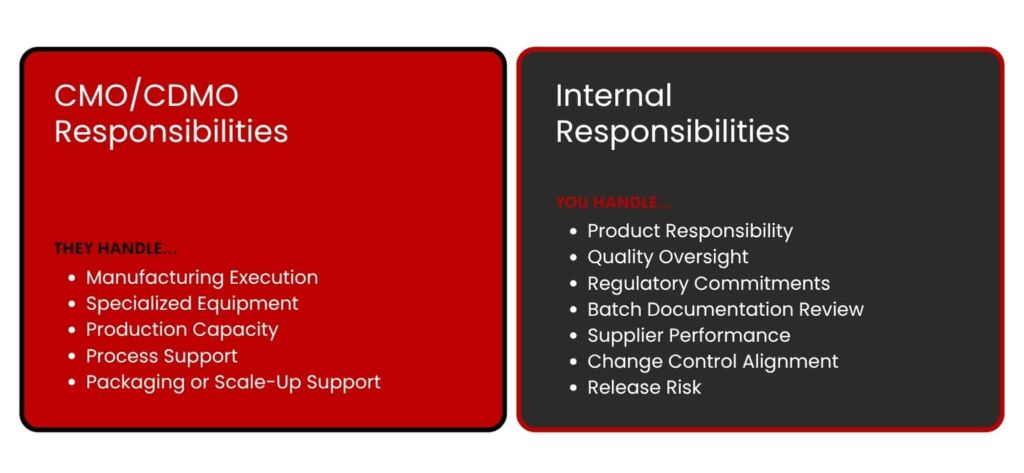
Life sciences companies can outsource manufacturing capacity, but they can’t outsource product responsibility. Pharmaceutical and biotech companies increasingly rely on contract manufacturing organizations (CMO) and contract development and manufacturing organizations (CDMO) to support development, scale-up, clinical supply, commercial production, packaging, and related technical work.
A strong CMO or CDMO relationship can give a company access to facilities, equipment, technical capabilities, and manufacturing experience that would be expensive or slow to build internally. The risk appears when companies assume that outsourced execution reduces the need for internal expertise. In reality, outsourcing just changes the kind of expertise required.
Quality oversight, validation, technical transfer, documentation, supplier management, and regulatory coordination still need qualified people who understand regulated manufacturing work.
For companies managing a launch, audit, remediation effort, tech transfer, or manufacturing workload spike, the staffing question becomes practical: who will keep the work moving when the internal team is already stretched?
Table of Contents
Overview of CMOs & CDMOs in Life Sciences Manufacturing
A CMO, or contract manufacturing organization, helps pharmaceutical and biotechnology companies manufacture drug substances, drug products, or related materials. Depending on the engagement, that support may include commercial manufacturing, formulation development, analytical method development, stability testing, registration batches, packaging, or scale-up support.
A CDMO, or contract development and manufacturing organization, typically offers a broader model. CDMOs combine development and manufacturing services, which can reduce handoffs between formulation, process development, clinical supply, commercial manufacturing, packaging, quality, and technical transfer. For companies that want fewer vendor transitions, the CDMO model can provide more continuity across the product lifecycle.
CMO vs. CDMO: The Practical Difference
The practical difference comes down to scope.
- A CMO may fit when the process is already defined and the company primarily needs manufacturing capacity.
- A CDMO may fit when the company also needs development, scale-up, formulation, clinical materials, regulatory support, or technical transfer support.
- A CRO supports research and clinical trial operations rather than manufacturing execution.
The more integrated the partnership becomes, the more important governance and oversight become. A company that relies on a CDMO across several stages of development and manufacturing needs clear ownership for documentation, quality decisions, technical transfer, regulatory commitments, and supplier performance.
Why Life Sciences Companies Use CMOs and CDMOs
Life sciences manufacturing is capital-intensive, highly regulated, and difficult to scale quickly. A company may have a strong molecule, platform, or product pipeline without having the internal facilities, equipment, quality systems, or manufacturing staff to support every stage of development and commercialization.
CMOs and CDMOs help fill that gap. They can provide access to specialized equipment, established manufacturing environments, technical teams, and production capacity. For smaller and mid-sized biotech companies, that access can be especially important because building a facility before product demand is proven creates a major financial risk. For larger organizations, outsourcing can support demand spikes, product launches, clinical supply needs, or capacity constraints across a broader network.
Common Reasons Companies Use Contract Manufacturing Partners
Life sciences companies often turn to CMOs and CDMOs when they need to:
- Add manufacturing capacity without building a new facility
- Access specialized equipment or technical capabilities
- Support clinical trial supply or commercial production
- Prepare for a product launch or demand increase
- Reduce handoffs between development and manufacturing teams
- Manage production needs without expanding permanent headcount too quickly
- Improve speed when internal facilities are limited or unavailable
The CDMO market reflects how central this model has become. Fortune Business Insights valued the global CDMO market at $255.01B in 2025 and projected growth to $580.72B by 2034. The same source reported that the CMO segment held the largest service share, tied to strategic partnerships for finished product and API manufacturing.
Outsourcing Manufacturing Doesn’t Outsource Accountability
A manufacturing partner can execute the work, but the sponsor still needs enough internal or embedded expertise to manage the relationship. That includes reviewing quality agreements, monitoring supplier performance, coordinating technical transfer, managing change controls, reviewing batch documentation, supporting deviation investigations, and keeping regulatory commitments aligned with manufacturing reality.
The workload in these situations often sits between functions. Quality needs batch records and deviation packages reviewed. Regulatory needs current CMC information. Supply chain needs reliable production and inventory visibility. Manufacturing and MSAT teams need process knowledge transferred clearly. Project leaders need deadlines, risks, and responsibilities made visible before they become release delays.
Where CMO/CDMO Partnerships Create Internal Workload
Outsourced manufacturing often adds work in areas that already operate under deadline pressure, including:
- Quality agreement review
- Batch record review
- Deviation and CAPA management
- Change control review and approval
- Validation protocol and report review
- Analytical method transfer
- Technical transfer documentation
- Supplier quality oversight
- Regulatory submission support
- Production planning and inventory coordination
- Audit preparation and response
- Documentation cleanup after manufacturing or quality changes
The pressure increases when the work is tied to a milestone. A clinical batch, process validation campaign, commercial launch, regulatory submission, supplier transition, or audit response can create temporary demand that internal teams weren’t staffed to absorb. That doesn’t always justify permanent hiring, but it does require capable support.
PeopleSolutions offers life sciences contract staffing as support for temporary or project-based needs like this. We work with biotech, pharmaceutical, medical device, and clinical research organizations to help them find temporary staff including QA/QC specialists, regulatory professionals, validation engineers, laboratory scientists, and manufacturing support roles.
Quality Oversight Is the Core Risk in CMO/CDMO Manufacturing
Quality oversight is where CMO/CDMO partnerships become operationally serious. A delay in batch record review, an unresolved deviation, a weak CAPA response, or incomplete validation documentation can affect product release, inspection readiness, and supply continuity. The issue isn’t only whether the manufacturing partner has a quality system. The sponsor also needs the capacity to review, challenge, document, and coordinate decisions across the relationship.
FDA’s FY2024 Report on the State of Pharmaceutical Quality shows the scale of the environment. At the end of FY2024, CDER’s Site Catalog included 4,619 manufacturing sites globally, with 41% located in the United States. FDA also reported 972 FDA-conducted drug quality assurance inspections in FY2024, a 27% increase from FY2023.
That kind of global manufacturing network creates real oversight demands. More sites, more handoffs, and more supplier relationships mean more places for quality issues, documentation gaps, and accountability questions to emerge.
CMO/CDMO Partnerships Add Pressure to Quality System Consistency
The ability to provide quality oversight internally is becoming increasingly important due to recent regulation changes. In the EU, EUDAMED is making device data easier to compare across identifiers, certificates, safety reports, and registration records. In the U.S., FDA’s Quality Management System Regulation is moving inspections toward an ISO 13485-aligned structure that tests whether complaints, risk files, supplier controls, and CAPA records connect logically.
These regulations matter for CMO/CDMO partnerships because outsourced manufacturing expands the number of places where records can drift apart. A supplier issue handled by the manufacturing partner still needs to connect back to the sponsor’s risk documentation, quality records, regulatory commitments, and corrective action process. A labeling, process, component, or specification change may touch multiple systems before anyone realizes the documentation no longer tells one consistent story.
Companies need people who can follow quality events across organizational boundaries, not just process paperwork inside one department. Supplier quality, QA, regulatory affairs, validation, document control, and project leadership all need enough capacity to keep the sponsor and manufacturing partner aligned before an audit, submission, shortage risk, or release delay exposes the inconsistencies.
Strong internal teams don’t remove every risk, but they improve the odds that problems are caught early and handled with the right technical and regulatory judgment.
Quality Roles That Support CMO/CDMO Oversight
The roles behind manufacturing oversight are specific. Companies often need support from:
- QA specialists
- QC professionals
- Supplier quality specialists
- Validation engineers
- Quality engineers
- Regulatory affairs specialists
- Document control professionals
- Technical writers
- MSAT professionals
- Manufacturing support staff
- GMP compliance professionals
When those teams are understaffed, the risk isn’t abstract. Work slows, decisions back up, and the company has less room to respond when a manufacturing issue becomes urgent.
The Workforce Behind a Strong CMO/CDMO Partnership
The success of a CMO/CDMO relationship depends on the people managing the space between the sponsor and the manufacturing partner. That work is less visible than facility capacity, but it often determines whether timelines hold.
Quality and Compliance Roles
Quality and compliance roles keep the partnership grounded in Good Manufacturing Practice (GMP) expectations. They review documentation, support audits, evaluate deviations, manage CAPAs, assess supplier performance, and make sure quality agreements are more than paperwork.
These roles may include:
- QA specialists
- QC analysts
- Supplier quality professionals
- GMP compliance specialists
- Audit readiness support
- CAPA and deviation support
Validation and Technical Roles
Validation and technical roles protect process reliability. These professionals help make sure process transfer, equipment readiness, method transfer, cleaning validation, and production scale-up are handled with enough technical discipline.
These roles may include:
- Validation engineers
- Process engineers
- Manufacturing engineers
- MSAT professionals
- Process development specialists
- Equipment qualification specialists
- Cleaning validation specialists
Regulatory and Documentation Roles
Regulatory and documentation roles keep the product record aligned. Manufacturing changes, submission commitments, protocols, reports, and controlled documents need to stay current and defensible.
These roles may include:
- Regulatory affairs specialists
- CMC support professionals
- Document control specialists
- Technical writers
- Change control support
- Quality documentation reviewers
Supply Chain and Project Coordination Roles
Supply chain and project coordination roles keep the work moving. These professionals connect manufacturing schedules to business needs, release timelines, inventory planning, and patient access.
These roles may include:
- Supply chain analysts
- Production planners
- Procurement support
- Vendor management professionals
- Project managers
- Manufacturing coordinators
These roles don’t replace the CMO or CDMO. They make the partnership more manageable. Outsourced manufacturing creates more coordination work, not less, because the sponsor still needs to understand what is happening, why it matters, and what must happen next.
When Contract Staffing Makes Sense Around CMO/CDMO Manufacturing
Permanent hiring isn’t always the right response to an outsourced manufacturing workload. Some needs are urgent but temporary. Others are tied to a defined project, milestone, or risk window. A product launch, validation campaign, audit preparation effort, remediation project, tech transfer, supplier transition, or manufacturing scale-up may require experienced support for months rather than years.
Common Situations Where Flexible Staffing Helps
Contract or project-based staffing can make sense when a company needs support for:
- Product launches
- Clinical or commercial manufacturing scale-up
- Process validation campaigns
- Audit preparation or inspection response
- Quality remediation projects
- Technical transfer
- Supplier transitions
- Documentation backlogs
- Deviation or CAPA workload spikes
- Regulatory submission support
- Facility expansion or equipment qualification
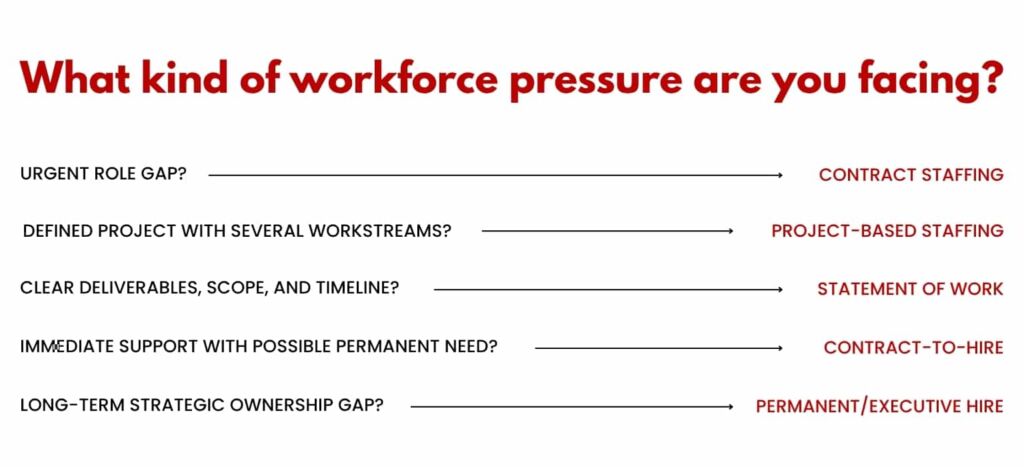
Contract staffing works when a company needs hands-on expertise embedded inside the team. That can include QA reviewers, validation engineers, regulatory affairs specialists, documentation professionals, manufacturing support, or supply chain specialists who can step into an existing process and help clear the workload.
Project-based staffing can make sense when the company needs several professionals aligned around a defined initiative.
Statement of work staffing may fit when the business wants scope, deliverables, timing, and accountability tied to an outcome rather than simply filling a seat.
Contract-to-hire can work when the company needs support immediately but may want the option to convert the person into a permanent employee later.
The stronger approach is to match the staffing model to the work. A six-month validation push, an audit remediation backlog, and a long-term supplier quality leadership gap may all require different hiring structures.
If you need help figuring out which approach is right for your situation, reach out to our team to start the discussion!
Building a Talent Strategy Around CMO/CDMO Manufacturing
CMO/CDMO partnerships work best when companies are clear about what the partner owns and what the sponsor must still control. Manufacturing execution may sit outside the company, but product knowledge, quality accountability, regulatory commitments, and supply risk still require internal leadership.
Questions to Help You Plan Your Talent Acquisition Strategy
A practical workforce plan starts by mapping the handoffs:
- Which team reviews batch records?
- Who owns deviation review?
- Who approves change controls?
- Who manages the technical transfer package?
- Who keeps CMC documentation aligned with manufacturing changes?
- Who tracks supplier risk before it affects release or supply?
- Who supports audit readiness?
- Who steps in when validation, documentation, or quality workloads spike?
Those questions should be answered before deadlines approach. Waiting until a validation campaign is behind, an audit is scheduled, or a quality issue is already delaying release leaves less room to find qualified support.
For many life sciences companies, the right model is a blend: keep strategic ownership internal, rely on CMOs or CDMOs for specialized manufacturing execution, and use contract or project-based talent when workload exceeds internal capacity.
CMO/CDMO Outsourcing Still Depends on the Right People
CMO/CDMO outsourcing can improve speed, flexibility, and manufacturing access, but the model still depends on the work of skilled people. The companies that manage these partnerships well don’t treat outsourcing as a way to step away from the work. They build enough internal and contract support around quality, validation, documentation, technical transfer, supplier performance, and supply continuity to keep the relationship controlled.
When the workload is tied to a launch, audit, remediation effort, validation project, tech transfer, or manufacturing surge, flexible staffing can give life sciences teams the capacity they need without creating permanent headcount for temporary pressure.
PeopleSolutions supports life sciences companies with contract, project-based, contract-to-hire, and SOW staffing for regulated environments. Reach out today to plan your temporary talent acquisition strategy with our team!
FAQ
What is the difference between a CMO and a CDMO?
A CMO focuses primarily on manufacturing support, while a CDMO combines development and manufacturing services. A CDMO may support formulation, process development, scale-up, clinical supply, commercial production, packaging, quality, and technical transfer under a more integrated model.
Why do life sciences companies use CMOs and CDMOs?
Life sciences companies use CMOs and CDMOs to access manufacturing capacity, specialized equipment, technical expertise, and regulated production environments without building every capability internally. The model can support clinical supply, product launches, commercial production, and demand spikes.
Does outsourcing manufacturing reduce staffing needs?
Outsourcing may reduce the need to hire certain production roles internally, but it often increases the need for quality, validation, regulatory, documentation, supplier management, and project coordination support. The sponsor still needs qualified people to manage oversight and accountability.
What roles support CMO/CDMO partnerships?
Common roles include QA specialists, QC professionals, supplier quality specialists, validation engineers, quality engineers, regulatory affairs specialists, MSAT professionals, process engineers, document control specialists, technical writers, supply chain analysts, and project managers.
When should a company use contract staffing for CMO/CDMO manufacturing?
Contract staffing makes sense when the need is urgent, specialized, or tied to a defined timeframe. Common examples include product launches, audit preparation, validation projects, technical transfers, remediation efforts, supplier transitions, and temporary manufacturing workload spikes.