
When a company needs people quickly, the decision often comes down to two options: bring in contract workers through a staffing firm, or hand hiring over to an RPO provider.
Both approaches are common and both are misunderstood.
Most confusion comes from one assumption: that short-term hiring automatically calls for contract staffing. That assumption is sometimes right. Often, it is not.
This article explains, in clear terms, what contract staffing and recruitment process outsourcing are designed to do, how they behave when demand is short-term, and how to choose between them without guesswork.
Table of Contents
What Contract Staffing Is Designed to Handle
Contract staffing is built for speed and simplicity.
A staffing firm recruits, employs, and pays the worker. The client company pays an hourly rate and gets labor quickly. When the work ends, the assignment ends.
This model works best when:
- The role is easy to define
- Training time is short
- The work can be paused or stopped without major disruption
Typical uses include seasonal volume, short coverage gaps, and project work where output matters more than continuity.
The key point is this: contract staffing is designed to fill labor gaps, not fix hiring systems.
What You Gain with Contract Staffing
Contract staffing removes several immediate burdens from the employer:
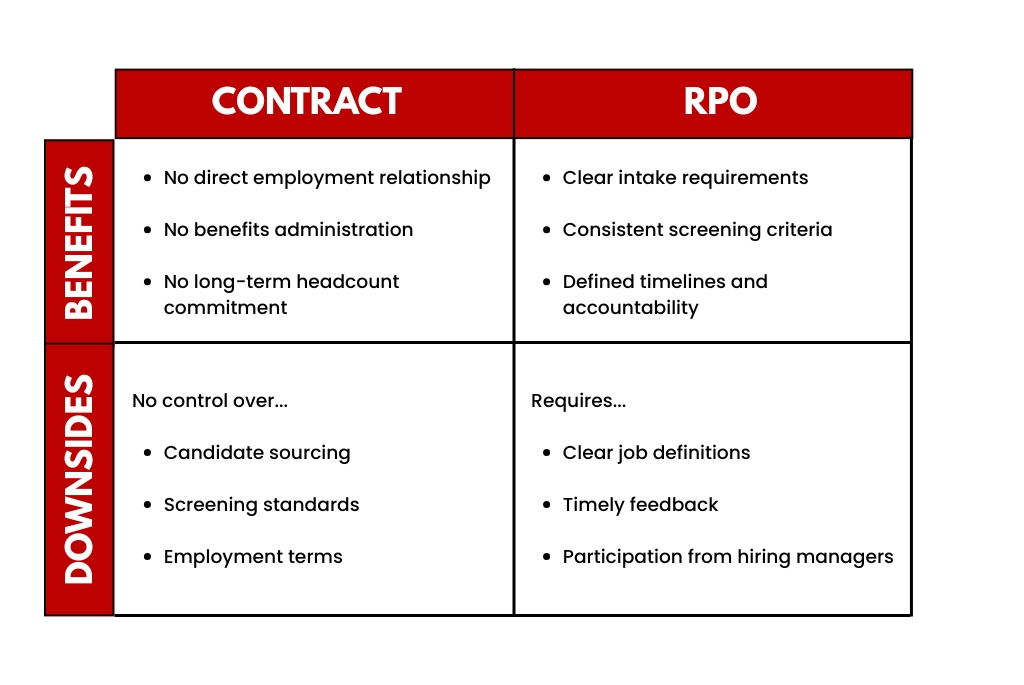
- No direct employment relationship
- No benefits administration
- No long-term headcount commitment
For a hiring manager under pressure, this can be the fastest way to get help in the door.
What You Give Up with Contract Staffing
What contract staffing trades away is control.
The staffing firm controls:
- Candidate sourcing
- Screening standards
- Employment terms
That loss of control usually shows up after the worker starts. Managers may need to correct work more often, replace contractors mid-assignment, or re-explain expectations that were not fully communicated upfront.
This is not a flaw in the model. It is the cost of speed.
What Recruitment Process Outsourcing Is Designed to Handle
Recruitment process outsourcing, or RPO, is designed to run hiring as an internal function, just operated by an external team.
The RPO provider manages recruiting tasks such as sourcing, screening, scheduling, and reporting. The company still hires the employee or contractor directly and keeps full control over pay, job design, and performance management.
RPO works best when hiring demand is expected to repeat, even if each role is short-term.
What You Gain With RPO
RPO provides structure.
That structure usually includes:
- Clear intake requirements
- Consistent screening criteria
- Defined timelines and accountability
Over time, this reduces rework. Hiring managers spend less time restarting searches and more time selecting from stable pipelines.
What RPO Requires from the Organization
RPO is not hands-off.
It requires:
- Clear job definitions
- Timely feedback
- Participation from hiring managers
If those conditions are missing, RPO feels slow and frustrating. That frustration often reflects internal indecision rather than provider performance.
Contract Staffing vs RPO for Short-Term Hiring
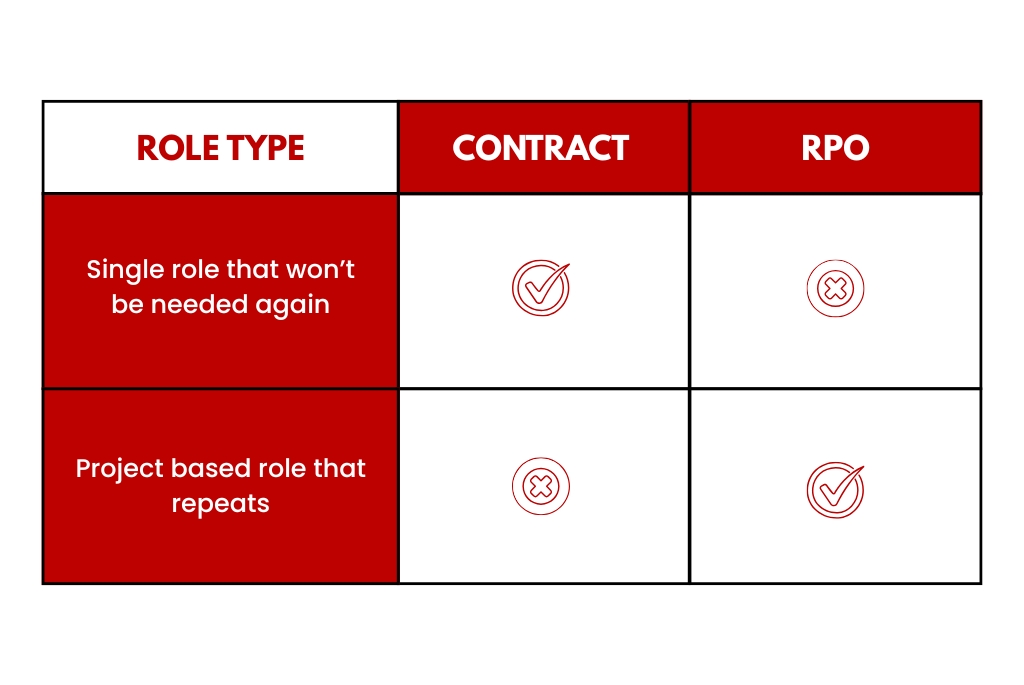
Short-term hiring does not automatically mean contract staffing. The real question is how often the same short-term problem appears.
If the Need Is One-Time
If the role truly will not repeat and speed is the main concern, contract staffing is usually the better option. The company avoids building a process for a problem that is unlikely to return.
If the Need Repeats
If similar short-term roles open every quarter or every project cycle, RPO often performs better over time.
The initial setup takes longer. After that, each hiring cycle requires less effort from managers and produces more consistent results.
Cost Differences That Matter in Practice
Contract staffing bundles costs into an hourly rate. It is easy to budget and hard to analyze.
RPO separates cost drivers. Fees are typically based on recruiter capacity or hiring volume. This makes inefficiencies visible.
Visibility can feel uncomfortable, but it also makes improvement possible.
Why Speed Alone Is a Bad Decision Rule
Many teams choose contract staffing because it is fast.
Speed helps when the work is simple. It hurts when the role affects customers, safety, or compliance.
Replacing a poor contractor mid-project often costs more time than a slower, better-defined hire would have taken.
Common Short-Term Hiring Mistakes
Short-term hiring fails most often for these reasons:
- Roles approved without clear scope
- Hiring managers disengage after kickoff
- Requirements change mid-search
Contract staffing absorbs these problems quietly. RPO forces them to be addressed.
Neither outcome is inherently better. The difference is whether the organization wants visibility or relief.
How Technology Changes the Decision in 2026
Access to candidates is no longer the main constraint.
Most organizations can find resumes quickly. The challenge is deciding who should move forward and why.
Contract staffing firms optimize for placement speed. RPO teams optimize for consistency and decision quality.
As automation improves sourcing, the value shifts toward process discipline rather than resume access.
Choosing the Right Model Without Overthinking It
Three questions usually clarify the choice:
- Will this type of role appear again within the next year?
- Does inconsistent performance create real risk?
- Can hiring managers participate consistently?
If the answer favors speed and isolation, contract staffing fits.
If the answer favors repetition and consistency, RPO usually performs better, even for short-term demand.
PeopleSolutions works with organizations for their contract staffing needs. For RPO services, we recommend you work with our partners over at WorkRocket.
The best outcomes come from matching the model to the problem, not the calendar.
Final Thought
Short-term hiring is not a shortcut around good decision-making.
Contract staffing and RPO both solve real problems. They fail when used as default answers instead of deliberate choices.
Speed is useful. Clarity is more durable.