
Public schools in the U.S. swing between chaos and quiet.
Schools don’t staff evenly throughout the year. Hiring runs on the academic calendar: districts start posting roles in late winter, fill most positions in late spring and early summer to be ready for August/September, then do another wave in late summer/early fall to cover last-minute gaps once enrollment and resignations shake out. The cadence repeats every year.
But facilities still need repairs. Networks need upgrades. Campuses need to prep before students return.
Seasonal contract work fills in the gaps where permanent positions don’t make sense. Schools get labor when they actually need it. Contractors get access to a market with clear, repeating demand windows. This piece walks through how seasonal contract work, particularly in IT and maintenance, makes schools run better during off-peak periods.
What Is Seasonal Contract Work in a School Context?
Seasonal contract work is a short-term, project-based hiring that lines up with predictable demand cycles.
In education, those cycles follow the academic calendar: summer break, winter recess, spring break, pre-opening campus prep, and end-of-year maintenance.
The IRS definition is straightforward. Seasonal employees work in positions where typical employment lasts less than 12 months during a calendar year because of recurring work patterns.
Schools fit this perfectly. Workloads expand and contract with the school year. Unlike retail or hospitality, you can see these swings coming months out. 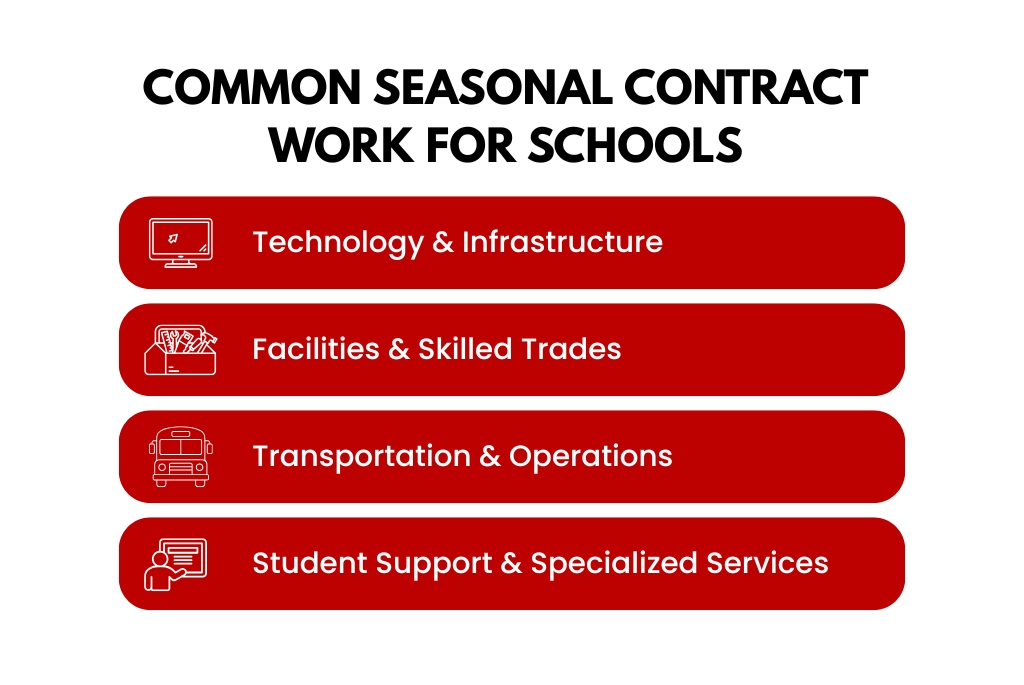
What Roles Typically Fall into Seasonal Contract Work
In practice, seasonal contract work in schools tends to cluster around four categories:
Technology and Infrastructure
- Network engineers and fiber technicians
- Device imaging and deployment teams
- Cybersecurity auditors
- Student information system (SIS) migration specialists
- Temporary help desk technicians during device rollouts
Facilities and Skilled Trades
- HVAC technicians and controls specialists
- Licensed electricians for panel upgrades and lighting retrofits
- Plumbing contractors
- Roofers and envelope repair crews
- Custodial teams for summer deep cleaning
- Flooring, painting, and classroom refurbishment crews
Transportation and Operations
- Contract bus drivers during driver shortages
- Fleet maintenance technicians
- Temporary routing and logistics support before the school year begins
Student Support and Specialized Services
- Contract speech-language pathologists
- Occupational therapists
- School psychologists
- Behavior intervention specialists
Many of these roles spike in summer. Others like specialized student services fluctuate during the academic year when caseloads exceed permanent staffing capacity.
Why Schools Face Staffing Gaps During Off-Peak Periods
Education is one of the few major U.S. employment sectors with obvious seasonal contraction.
BLS data shows local government education employment drops sharply each July and August, then rises again in September. Based on the data, local government education employment fell by about 1.36 million from May to July 2025, then jumped by about 1.09 million from July to September as schools staffed back up for the new year.
During these windows, districts typically bring in outside electricians, HVAC specialists, network engineers, custodial crews, and project managers to execute work that would be disruptive during active instruction.
Three things happen during off-peak months.
IT Infrastructure Gets Easier to Touch
Network upgrades, device refreshes, and cybersecurity audits are simpler when students aren’t around.
Through the federal E-Rate program alone, schools and libraries have access to more than $3.9 billion annually (adjusted annually for inflation) to fund broadband and network infrastructure. According to the CoSN State of EdTech District Leadership report, 66% of districts use outsourcing strategies for these IT functions.
Without kids occupying the school, this work can easily be done by seasonal contract workers over summer break.
Facilities Projects Pile Up
The U.S. Government Accountability Office found that 54% of public school districts need to update or replace building systems like HVAC, plumbing, or electrical infrastructure.
Large scale system replacements like these are nearly impossible to do with a building full of energetic kids that are trying to learn. Off-season is the only realistic window.
Permanent Staff Are Already Stretched
Most permanent teams run lean to begin with. The National Center for Education Statistics found that 69% of public schools reported trouble filling non-teaching positions heading into the 2023-2024 school year.
If a district can’t even fill basic custodial or tech roles, asking that same skeleton crew to tackle major seasonal projects doesn’t work. Seasonal contract work plugs the gap without adding permanent staff.
 The Budget Angle Schools Don’t Talk About Enough
Public schools work within fixed annual budgets.
Every permanent hire adds pension obligations, benefits, and long-term payroll commitments. The Bureau of Labor Statistics pegs employer benefit costs at roughly 34-36% of total compensation in state and local government related to the education system.
Seasonal contract work flips fixed personnel expense into variable project expense.
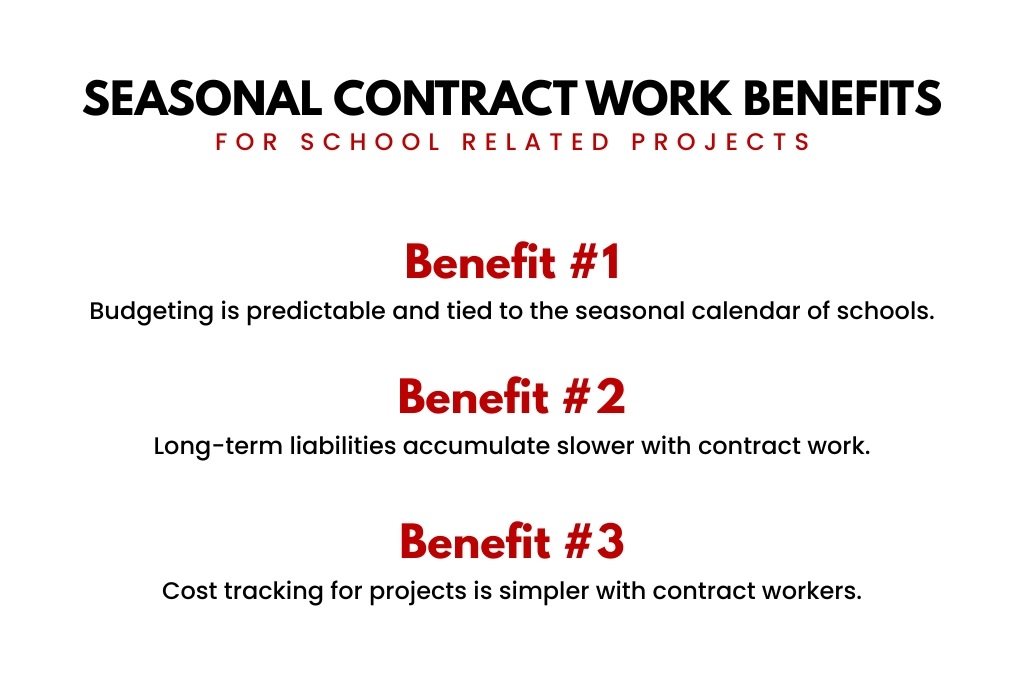
You get three wins: predictable budgeting tied to the calendar, slower growth in long-term liabilities, and cleaner cost tracking for capital versus operational spending.
This is how you match your cost structure to the way the work actually flows. Finance officers get this. A lot of operations leaders haven’t thought about it this way yet.
Why Temporary IT Staffing Is No Longer Optional In K-12
Technology isn’t infrastructure anymore. It’s how schools function.
Mid-sized districts manage thousands of devices. Each one needs maintenance, updates, endpoint protection, and eventual replacement.
K-12 IT volatility keeps climbing. Federal cybersecurity requirements get stricter. Device refresh cycles get shorter. Cloud migrations continue. Data privacy regulations shift.
You end up with project spikes that don’t justify hiring permanent staff in every district.
Temporary IT help during summer device imaging, cybersecurity audits, network hardware swaps, and learning management system migrations has become standard operating procedure.
Districts treating this as recurring strategy instead of emergency response deal with fewer fires.
Why Contractors Should Pay Attention to Education
From a contractor perspective, education offers something unusual: stable seasonality.
Construction and hospitality work ebbs and flows with economic cycles. School calendars don’t budge. Summer maintenance and IT demand happens every single year. Winter and spring breaks give you shorter project windows.
Learn the procurement cycles, background check requirements, and school board approval timelines, and you can land repeat work. Many districts publish capital improvement plans publicly. You get visibility into future projects that private sector work rarely offers.
Trades and IT professionals often default to commercial contracts and miss this entirely.
How Schools Should Actually Structure This Work In 2026
Execution separates smooth deployments from scrambling.
Start Planning Six to Nine Months Out
Capital improvement schedules are public. School calendars are public. Vendor onboarding requirements are documented.
Wait until May to line up summer contractors and you’re competing for whoever’s still available.
Write Clear Scope Documents
Vague deliverables lead to change orders and cost overruns.
Your statement of work needs access windows, security compliance requirements, completion milestones, and who’s accountable for what. Ambiguity costs money.
Connect Contractors with Internal Leads
Just because someone’s seasonal doesn’t mean they work in a vacuum.
Assign an internal project lead. You need knowledge transfer, proper documentation, and continuity after the contract ends. Treat contractors like temporary outsiders and you lose institutional memory.
Where PeopleSolutions Fits with Seasonal Contract Work for Schools
PeopleSolutions works where operational need meets labor strategy.
For districts weighing seasonal contract work, the question is how to structure it without inflating permanent overhead costs.
For contractors exploring education work, the opportunity is understanding the academic calendar rhythm and positioning your services to match.
Schools that treat off-season as a deployment window instead of downtime will run smoother.