
Most workforce discussions treat contract staffing and freelancers as interchangeable forms of flexibility. They are not. Confusing the two creates predictable problems: compliance exposure, cost overruns, stalled projects, and managers spending time policing work instead of moving it forward.
Interest in contract staffing vs freelancers has accelerated as U.S. employers recalibrate after years of remote expansion, regulatory scrutiny, and tighter labor markets. The surface-level comparisons miss what actually matters. Control, risk transfer, and internal management capacity decide whether either model works.
This article examines how the two models function in practice in the United States.
Table of Contents
Contract Staffing vs Freelancers: Where the Line Is Drawn
Contract Staffing in Operational Terms
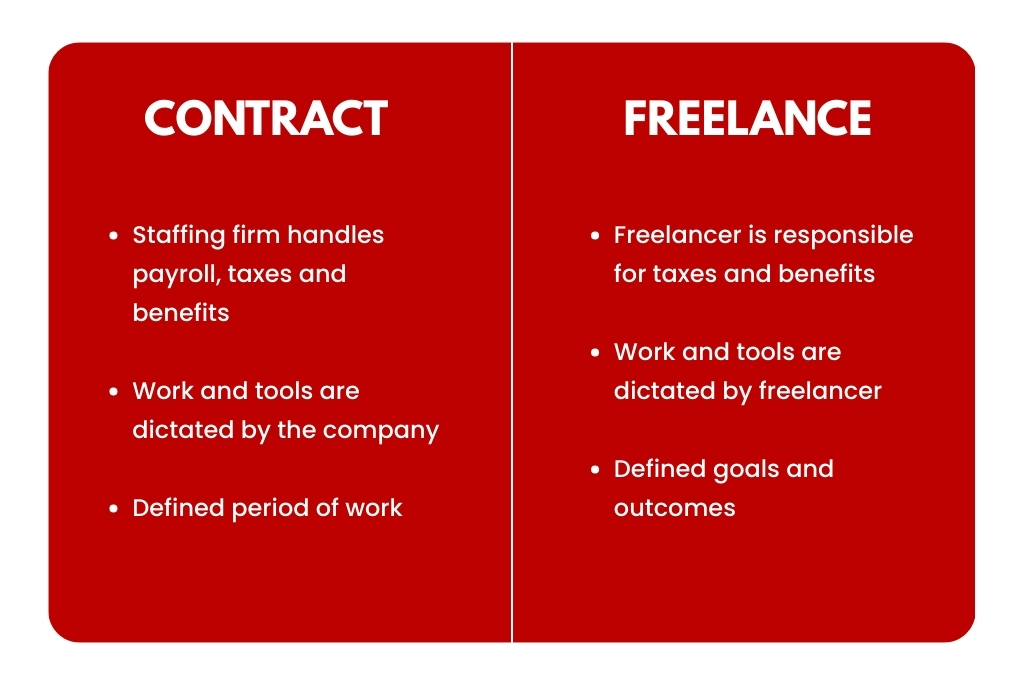
Contract staffing places the worker on a staffing firm’s payroll and partners with that individual to place them with a client for a defined period. The staffing firm is the employer of record. Payroll, taxes, benefits, and most compliance obligations sit outside the client organization.
This structure exists for a reason. It allows companies to direct daily work, integrate contractors into teams, and scale headcounts without inheriting a classification risk. Contract to hire arrangements extend this model by allowing performance evaluation before permanent employment.
Temporary staffing fits inside this framework. The duration changes, but the employment structure does not change.
Freelancers as Independent Businesses
Freelancers operate as independent contractors. They may be individuals or formal business entities, but the distinction is secondary. What matters is independence. Freelancers control how work is performed, supply their own tools, and assume responsibility for taxes and insurance.
The IRS evaluates classification using behavioral control, financial control, and the nature of the relationship. Those standards have not been loosened. If anything, enforcement has become more consistent.
Who’s in Control?
Control determines whether a worker can function inside an organization or must remain external.
Contract staff can be managed. They attend internal meetings, follow schedules, use company systems, and adapt to shifting priorities. The staffing firm absorbs the employment risk that makes this possible.
Freelancers cannot be managed the same way without crossing legal boundaries. Companies can define outcomes and deadlines. They cannot dictate process without increasing misclassification risk. When work requires frequent course correction, this limitation becomes obvious.
Teams that ignore this difference tend to experience the same failure mode. Managers start supervising freelancers informally, friction increases, and legal risk quietly accumulates.
Contract vs Freelancers: Cost Comparison
Freelancers often appear cheaper on paper. No markup. No benefits. No long-term commitment. That math holds only when work is tightly scoped and truly independent.
Contract staffing costs are explicit. Bill rates include wages, payroll taxes, benefits, and agency margin. Forecasting is straightforward.
Freelancer costs are fragmented. Rates fluctuate with demand. Internal time spent managing contracts, reviewing work, and resolving delays is rarely captured. When projects miss deadlines, the downstream cost shows up elsewhere.
The IRS warns that when a worker is treated as an independent contractor without a reasonable basis, the employer can be held liable for that worker’s employment taxes, with liability determined under federal rules such as IRC §3509.
At scale, that risk changes the cost equation.
Compliance Pressure Is Moving in One Direction
Worker classification remains an enforcement priority at both federal and state levels. The Department of Labor’s guidance continues to emphasize economic dependence and functional control.
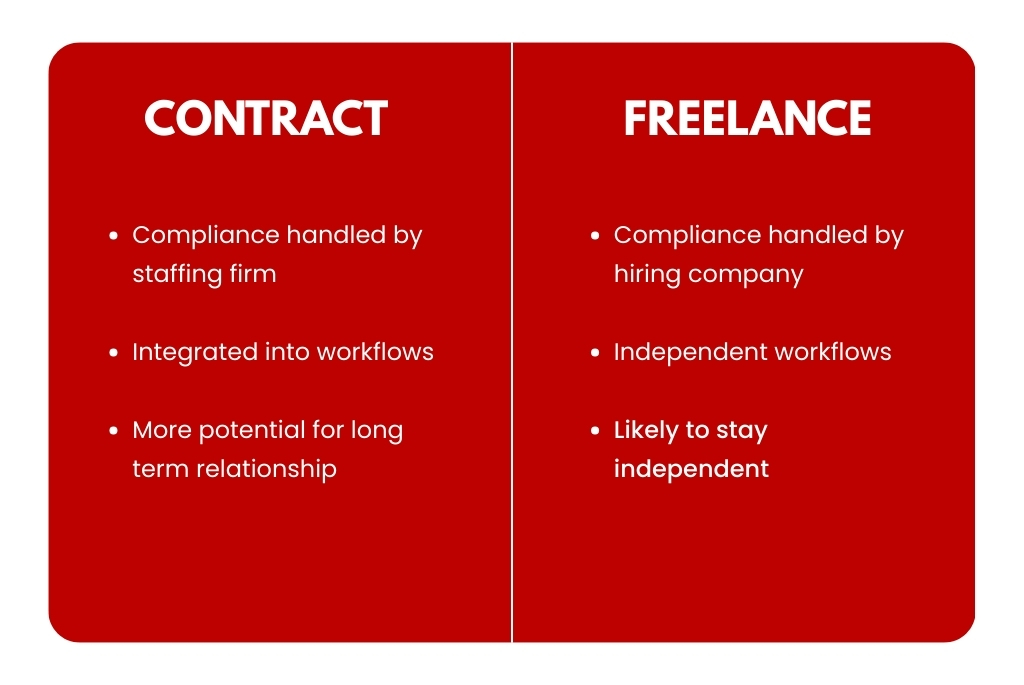
Contract staffing transfers most of that exposure to the staffing firm. That transfer is the product being purchased.
Freelancers place the burden on the hiring company. For short, specialized engagements, this is manageable. For ongoing operational roles, it is not.
California’s AB5 framework has reshaped enforcement by anchoring worker classification to a presumption of employment rather than independence. Under the ABC test, companies must affirmatively prove that a worker operates free from control, performs work outside the usual course of the company’s business, and runs an independently established enterprise.
Even in states that have not adopted AB5 outright, regulators increasingly mirror this logic during audits by scrutinizing economic dependence and functional integration, not contractual language. As a result, classification decisions that rely on narrow task-based definitions rather than business reality are more likely to fail under review.
Speed and Talent Access Differ
Staffing firms invest in ready talent. Pre-vetted pools shorten time to productivity, particularly in roles with repeatable skill requirements. Accounting, clinical operations, IT support, and compliance functions benefit from this model.
Freelancers dominate at the margins. When a narrowly defined expertise is needed for a discrete output, experienced freelancers deliver value quickly. Availability becomes the constraint. High-performing freelancers ration their time.
Integration Friction Is Often Underestimated
Contract staff integrate into workflows by default. They operate inside the organization without forcing structural workarounds.
Freelancers operate outside by necessity. Collaboration happens through checkpoints rather than continuous interaction. That distance protects independence but limits responsiveness.
In fast-moving environments, the difference shows up as missed handoffs, delayed approvals, and work that technically meets scope but fails operational reality.
Contract-to-Hire as a Risk Filter
Contract to hire arrangements function as controlled exposure. Companies assess performance, reliability, and team fit before committing to permanent headcount.
This approach has gained traction in regulated and capital-intensive industries where hiring errors carry lasting cost. It also appeals to professionals seeking income stability without immediate permanence.
Freelancers rarely transition cleanly into full-time roles. Independence is not incidental to their model. It is foundational.
What Drives the Decision Beyond Cost & Preference
Management Capacity Limits Flexibility
Most comparisons ignore the internal cost of managing non-employees. Freelancers require strong scoping, contract discipline, and vendor oversight. Without that infrastructure, performance degrades.
Contract staffing absorbs that complexity. The model assumes management limitations and compensates for them. Organizations that lack mature vendor management often mistake freelancer flexibility for simplicity.
Freelancing Is Polarizing
The freelance market is separating. High-skill specialists command premium rates and select engagements carefully. Lower-skill freelance work faces price compression from automation and global labor pools.
Contract staffing occupies the middle. It supplies experienced professionals who want stability without permanence. Demand in this segment continues to grow because it aligns with how most organizations operate.
When Contract Staffing Works Better
Contract staffing fits roles that require continuity, internal access, or regulatory oversight. It performs best where demand is sustained but not permanent.
Finance operations, healthcare support functions, IT infrastructure, and compliance-heavy roles consistently fall into this category.
When Freelancers Earn Their Place
Freelancers are effective when outcomes are discrete and autonomy is real. Creative production, specialized consulting, and one-off builds benefit from this structure.
The constraint is discipline. Loose scopes and ongoing dependencies undermine the model quickly.
Choosing Without Confusing the Models
The mistake is not choosing one model over the other. The mistake is applying the wrong expectations.
Treating freelancers like employees creates risks. Treating contract staff like vendors wastes value. Understanding the structural differences prevents both errors.
Conclusion
The question is not whether contract staffing or freelancers offer more flexibility. The question is which model aligns with the work, the risk profile, and the organization’s capacity to manage it.
In 2026, effective workforce strategies favor precision over ideology. Organizations that deploy each model where it functions avoid friction that no amount of flexibility can offset.
PeopleSolutions operates at this intersection daily, observing where contingent workforce decisions succeed and where they fail. That pattern recognition, more than preference, is what separates workable strategies from expensive experiments.
If you’re looking for an outside solution to assist you with your contract staffing needs, look no further than PeopleSolutions. Our team of contract staffing experts can help you find the talent you need without the risk of misclassification. Talk to one of our team members today!