Temporary staffing has become a structural part of how construction firms operate. Labor volatility, project-based work, and tighter compliance expectations have pushed many companies to rely on temporary and contract staffing well beyond peak season coverage.
For hiring managers and owners, the question is no longer whether temporary staffing is expensive. The real question is where the cost actually comes from, how it compares to full-time labor, and when the math favors one over the other.
This article breaks down the cost of temporary staffing in the U.S. construction industry with current data, realistic ranges, and clear comparisons.
What Determines the Cost of Temporary Staffing in Construction
Temporary, or contract, construction staffing costs are shaped by a combination of wage pressure, risk transfer, and administrative load. The hourly rate quoted by an agency is only the visible layer..
Several factors consistently drive pricing across markets.
Base Pay Rates by Trade and Skill Level
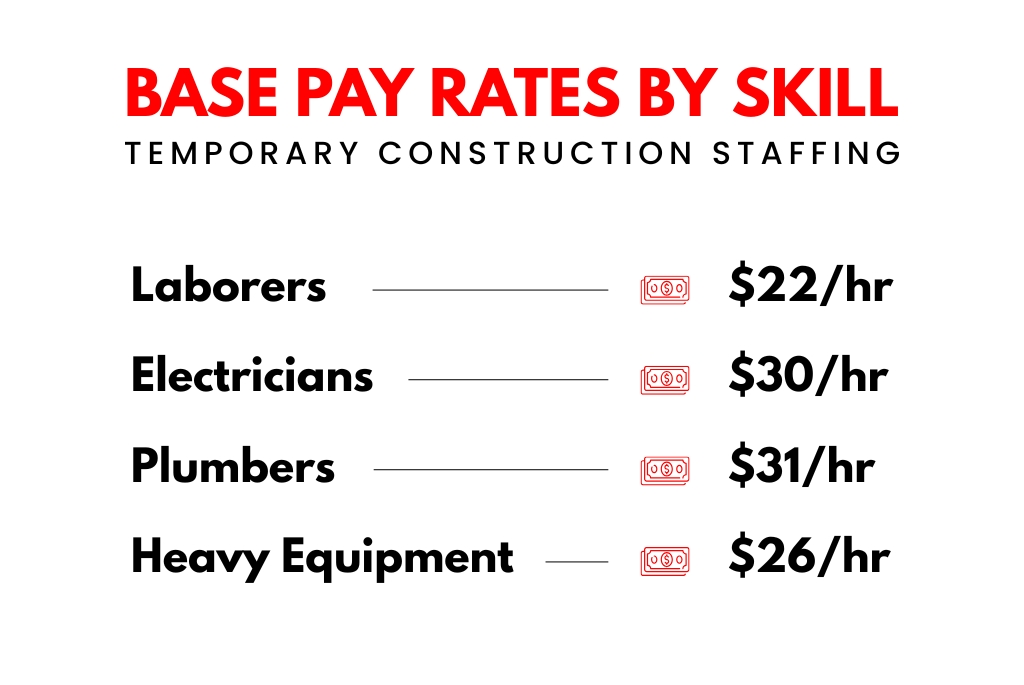
Wages remain the foundation. According to the U.S. Bureau of Labor Statistics, median hourly wages in construction vary widely by role:
- Construction laborers: about $22 per hour
- Electricians: about $30 per hour
- Plumbers, pipefitters, and steamfitters: about $31 per hour
- Heavy equipment operators: about $26 per hour
Temporary staffing rates build on these figures, not around them. Higher-skill and licensed trades carry tighter labor supply, which pushes both direct wages and markup higher.
Statutory Employment Costs
Even short-term workers trigger statutory obligations. These costs are embedded into temporary staffing rates:
- Employer share of Social Security and Medicare at 7.65%
- Federal and state unemployment taxes
- Workers’ compensation insurance, which is notably higher in construction
Workers’ compensation varies dramatically by classification. High-risk trades such as roofing can face workers’ comp premium rates above $19 per $100 of payroll, compared with less than $0.35 for low-risk roles, illustrating how costs can range from under 5% to over 20% of payroll depending on trade and state classifications.
Risk Transfer and Liability Coverage
One reason temporary staffing costs more per hour is liability transfer. The staffing provider carries responsibility for payroll compliance, tax filings, unemployment claims, and in many cases co-employment risk.
This matters in construction, where OSHA exposure, injury rates, and classification audits are nontrivial. Firms pay for that insulation whether they explicitly track it or not.
Average Cost of Temporary Construction Staffing In 2026
Temporary staffing costs are typically quoted as an all-in hourly bill rate rather than a wage-plus-fees breakdown. In 2026, most U.S. construction firms see the following ranges.
Typical Markup Ranges
For general construction roles, temporary staffing bill rates typically run 35% to 70% above base wages, reflecting employer payroll taxes, benefits and insurance costs documented by the Bureau of Labor Statistics, and operating margins typical of the temporary help services industry as reported by the U.S. Census Bureau.
A laborer earning $22 per hour may be billed at $30 to $37 per hour. A licensed electrician earning $30 per hour may be billed at $42 to $50 per hour.
The markup covers employment taxes, insurance, overhead, compliance, and agency margin. It does not automatically indicate inefficiency.
Regional Variability
Labor markets remain fragmented. States with large infrastructure pipelines and housing shortages tend to carry higher bill rates.
California, Texas, Florida, Arizona, and the Carolinas consistently post higher temporary staffing costs due to volume demand and regulatory complexity.
Average Cost to Hire a Full-Time Construction Employee
Temporary staffing only looks expensive when full-time hiring costs are underestimated. Many are.
 Direct Compensation Costs
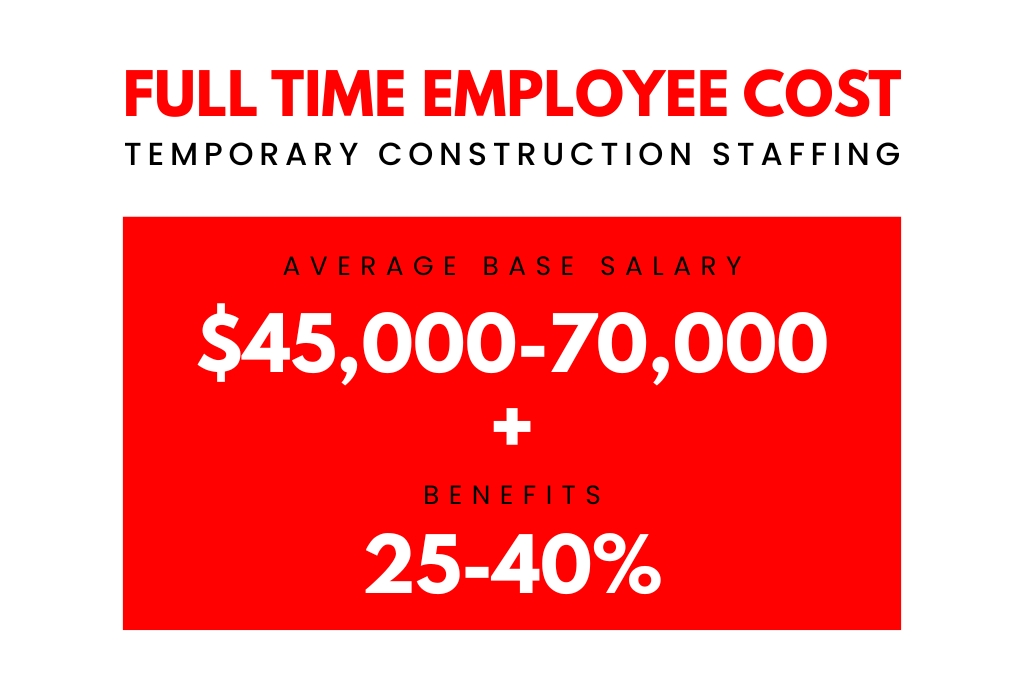
According to the U.S. Bureau of Labor Statistics, annual wages for common construction roles such as laborers, carpenters, electricians, and plumbers typically range from about $45,000 to nearly $70,000 before benefits, depending on trade and experience
That number rarely reflects the true employment cost.
Benefits and Overhead Add 25-40%
Federal data and industry surveys consistently show that benefits and overhead add substantial load:
- Health insurance and retirement contributions
- Paid leave and holidays
- Training and certification maintenance
- Safety programs and equipment
The Bureau of Labor Statistics estimates that benefits account for roughly 33% of total compensation across private industry, with construction often exceeding that average.
A $60,000 salaried employee often costs $78,000 to $85,000 annually once fully loaded.
Hiring and Ramp-Up Costs
Hiring itself carries costs. Job advertising, recruiter time, onboarding, training, and early-stage productivity drag are rarely itemized but always present.
For project-driven firms, this becomes especially costly when workload drops or timelines shift.
Temporary Staffing vs Full-Time Labor: Cost Comparison
The comparison changes depending on the time horizon and utilization.
Short-Term and Variable Demand Favors Temporary Staffing
When labor demand is tied to a defined project window, temporary staffing often costs less in aggregate despite higher hourly rates.
There are no benefit tails, no severance risk, and no underutilized payroll during downtime. Cash flow aligns with revenue more cleanly.
This is common on infrastructure projects, site preparation phases, or seasonal commercial builds.
Sustained Demand Favors Full-Time Employment
Once utilization exceeds roughly nine to twelve months of continuous work, the economics begin to shift.
Full-time employees become cheaper on an annualized basis, especially when turnover is low and training investments are amortized over years rather than months.
This is why core crews remain permanent while peak labor flexes.
Why Construction Firms Often Underestimate Temporary Staffing ROI
Most cost comparisons stop at hourly rates. That misses two structural effects.
Productivity Risk Is Lower with Temporary Staff
Temporary construction workers are typically deployed into defined scopes with minimal role ambiguity. That reduces misalignment and limits productivity drift.
In practice, this often leads to higher task-level efficiency even when hourly costs are higher.
Administrative Tasks Scale Faster Than Team Size
Payroll, compliance, and safety oversight do not scale linearly. Each new full-time employee adds disproportionate management overhead.
Temporary staffing shifts much of that burden externally. For small and mid-sized contractors, this can delay the need for additional HR or compliance staff altogether.
Wage Pressure and the Cost Outlook
Construction wages continue to face upward pressure.
The BLS projects steady demand for construction labor driven by infrastructure investment, energy projects, and housing supply constraints.
Temporary staffing rates will continue to rise, but not always faster than full-time labor costs. Insurance, compliance, and benefits inflation affect both models.
The difference lies in flexibility.
When Temporary Construction Staffing Is the Lower-Risk Option
Temporary staffing often makes the most financial sense under three conditions:
- Project durations under one year
- Uncertain funding or permitting timelines
- Roles with higher injury or compliance exposure
In these scenarios, the premium paid per hour often functions as insurance against far larger downstream costs.
How PeopleSolutions Approaches Cost Transparency
PeopleSolutions works with construction firms that want predictability. Cost clarity matters more than nominal hourly rates.
The goal is alignment between labor strategy, project timelines, and financial reality. Temporary construction staffing is one tool among many, but when used deliberately, it controls risk as much as it fills roles.
Key Takeaways for Construction Hiring Leaders
Temporary staffing costs more per hour and less per mistake. Full-time labor costs less per hour and more per commitment.
In 2026, the firms that manage labor well are not choosing one model exclusively. They are calibrating both based on project duration, risk tolerance, and utilization.
Understanding the true cost of temporary staffing makes that calibration possible.
Do you want a more accurate estimate of the cost of temporary construction staffing? Talk to the experts at PeopleSolutions! We’ll get to know you, your business and your needs so we can accurately estimate the cost of temporary staffing for your business.