
A career shift from a full-time role to contract work usually doesn’t start with dissatisfaction. It starts with opportunity.
A high-impact project opens up. A team needs immediate expertise. The timeline is tight, and leadership doesn’t have the luxury of a long hiring cycle. Instead of posting a full-time role, they fund a contract position.
The offer looks attractive: higher pay, faster start, clearer scope. But behind the numbers sits a real question:
Is moving from full-time employment to contract work actually worth it long term?
The answer depends on math, timing, and intent. Let’s break it down.
Quick Answer: When a Contract Job Is Worth It
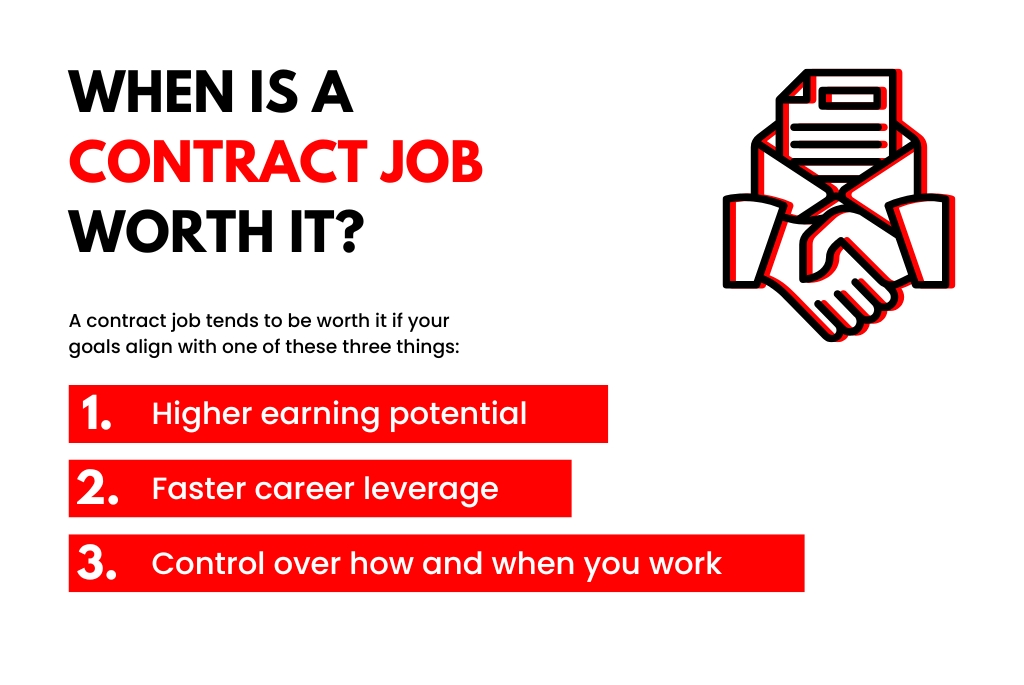
A career shift into contract work tends to pay off when it aligns with one of three goals:
- Higher earning potential
- Faster career leverage
- Greater control over how and when you work
Contract roles often make sense when the pay increase is large enough to replace benefits and cover gaps between projects, or when the role provides access to skills, industries, or leadership exposure that would take years to reach in a traditional full-time path.
On the other hand, contract work is rarely a good move when financial margins are thin, benefits are non-negotiable, or stability outweighs flexibility.
A Simple Reality Check
One useful benchmark is this: If a contract role does not pay at least 25–50% more than your fully loaded full-time compensation, it’s usually not worth the switch.
That margin exists for a reason. According to the U.S. Bureau of Labor Statistics, employer-paid benefits account for over 38.5% of total compensation costs for civilian workers as of mid-2025.
When benefits disappear, the contract rate has to replace them… and then some.
Full-Time vs. Contract: What Actually Changes
The biggest mistake professionals make when considering a career shift to contract work is comparing salary to hourly pay at face value. The reality is more nuanced.
Pay Structure and Predictability
Full-time roles trade upside for consistency. You’re paid to be available, not just productive. Contract roles, by contrast, are paid for output and urgency. Companies are willing to pay more per hour because the commitment is shorter and the expectations are clearer.
This can be a major advantage for experienced professionals who can deliver quickly, but it also means performance matters more.
Benefits and Hidden Costs
Benefits are often the deal-breaker. Employer-sponsored health insurance, retirement matching, and paid time off are expensive to replace independently.
The Kaiser Family Foundation’s 2025 Employer Health Benefits Survey reports that average annual premiums reached $9,325 for individual coverage and $26,993 for family coverage, continuing a multi-year upward trend.
This doesn’t mean contract work is unaffordable, but it does mean benefits must be factored into the rate, not treated as an afterthought.
How PeopleSolutions Handles Benefits
While many contract roles may not offer benefits to their employees, contract workers employed through PeopleSolutions will have access to benefits.
After the first 60 days of employment for PeopleSolutions, you are eligible to enroll for health and dental insurance. After 90 days, you will start receiving paid time off (PTO). Additional benefits include time and a half pay for overtime and an option to receive your paychecks via direct deposits.
Taxes and Classification
Not all contract roles are created equal. W-2 contract positions often resemble full-time roles with fewer benefits, while 1099 or corp-to-corp roles provide more autonomy but require greater tax planning and compliance awareness.
The difference affects cash flow, deductions, and long-term planning; another reason a thoughtful approach matters.
The Real Math Behind a Career Shift
Instead of guessing, it helps to compare offers using a consistent framework.
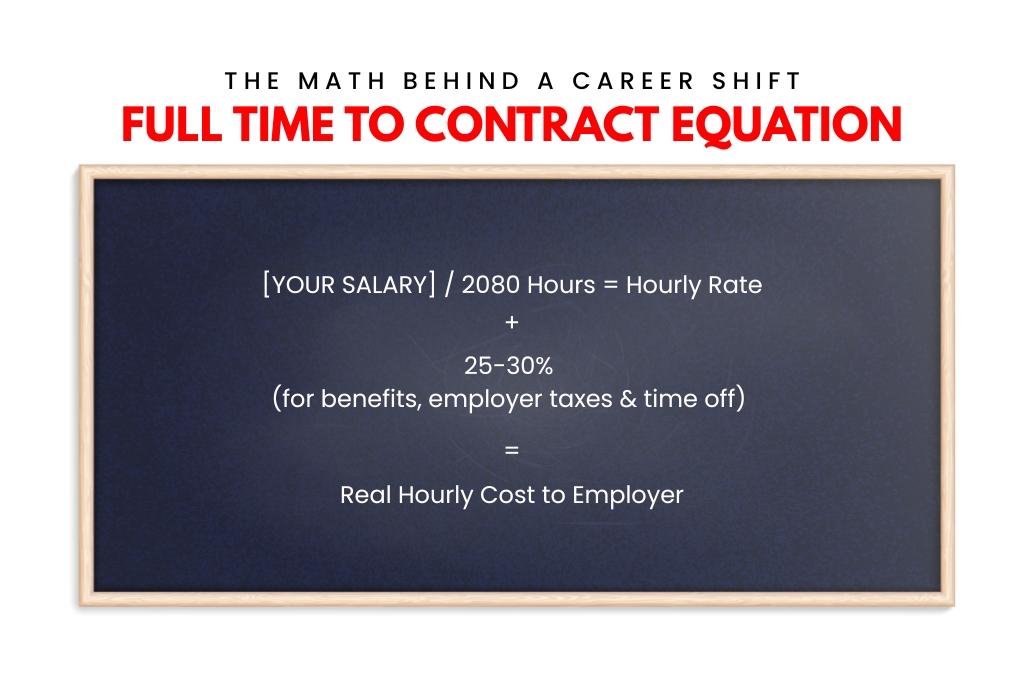
Start by converting your salary into an hourly rate. Divide your annual salary by 2,080 hours, then add 25-35% to account for benefits, employer taxes, and paid time off.
A $100,000 salary, for example, translates to roughly $48 per hour. Once benefits are included, the real cost to your employer is closer to $60-65 per hour.
Now compare that number to the contract rate, adjusting for unpaid time off, insurance costs, and potential gaps between roles. If the contract rate doesn’t clearly exceed your fully loaded hourly value, the move may stall rather than accelerate your career.
This is where working with a partner like PeopleSolutions matters. Market-rate context removes guesswork and prevents costly miscalculations. We can help you navigate complex salary negotiations with employers to ensure you accelerate your career.
The Upside of Contract Work
When structured correctly, contract roles can unlock advantages that traditional full-time paths rarely offer.
Higher Earning Potential
Contract roles often command premium pay when skills are scarce or timelines are aggressive. According to the Bureau of Labor Statistics, contingent and alternative work arrangements continue to represent millions of U.S. workers, particularly in specialized and project-based roles.
Professionals with in-demand expertise often find that contract work compresses earning growth into a shorter timeframe.
Faster Skill Accumulation
Contract work exposes professionals to new systems, teams, and challenges at a faster pace. Instead of growing vertically within one organization, contractors often grow laterally across industries and functions.
This type of skill stacking can dramatically increase long-term market value.
Greater Career Control
For professionals seeking flexibility, whether due to caregiving, burnout recovery, or geographic freedom, contract roles provide options that traditional employment often cannot.
The Trade-Offs (and How to Reduce the Risk)
Every career shift has trade-offs. Contract work is no exception.
The most common challenge is income volatility. Even strong contractors experience downtime between engagements. Without preparation, those gaps can create stress that overshadows the benefits.
Another challenge is benefits management. Health insurance, retirement savings, and paid time off don’t disappear; they shift from employer responsibility to personal planning.
There’s also a mental load. Contractors must think not only about current performance but about the next role, the next renewal, and the next opportunity.
These risks can be reduced with three fundamentals: adequate savings, a steady opportunity pipeline, and clear contract terms.
How to Make a Career Shift Without Regret
The professionals who thrive in contract work rarely jump blindly. They transition intentionally.
One effective approach is starting with a W-2 contract role, which offers simpler taxes and fewer administrative hurdles. Another is building a 90-day opportunity pipeline before leaving a full-time role, ensuring options exist beyond the first contract.
Equally important is planning for benefits and savings before the first day of contract work. Treating healthcare, taxes, and retirement as fixed monthly costs (not optional expenses) creates stability even when income fluctuates.
What to Clarify Before Accepting a Contract Role
Before saying yes, clarity matters more than enthusiasm. Understanding the expected duration, likelihood of extensions, weekly hours, and payment terms prevents surprises later.
Expense policies are also critical. For roles involving travel or driving, it helps to know that the IRS standard mileage rate for business use increased to 72.5 cents per mile for 2026, which can significantly affect reimbursement discussions.
Clear scope, ownership of deliverables, and confidentiality terms should never be assumed; they should be defined.
Common Questions About Contract Career Shifts
Many professionals worry that contract work may hurt their resume. In practice, well-positioned contract roles often strengthen it by highlighting outcomes, adaptability, and measurable impact.
Others worry about economic uncertainty. While no role is recession-proof, contract work can offer resilience when companies hesitate to add permanent headcount but still need execution.
The key is selectivity. Not every contract role is worth taking, but the right one can redefine a career trajectory.
How PeopleSolutions Supports Smarter Career Shifts
A career shift from full-time employment to contract work shouldn’t feel like a gamble.
PeopleSolutions helps professionals evaluate contract opportunities through real market data, realistic rate guidance, and role alignment. The goal isn’t simply to land a contract, but to ensure it advances both income and long-term career value.
If you’re considering contract work and want to make the move with confidence, PeopleSolutions can help you determine whether the shift is truly worth it and how to do it right.