
Data center construction no longer behaves like standard commercial work. Schedules are shorter, systems are denser, and tolerance for delay is minimal. Across the country, especially in Virginia, builders are being asked to deliver power-heavy, redundancy-driven facilities on timelines that leave little room for workforce misalignment.
That pressure is exposing a weakness in traditional construction hiring models. Permanent headcounts grow too slowly. General labor pools lack the right certifications. Reactive staffing decisions show up later as missed inspections or delayed commissioning.
Project-based recruitment has emerged as a response to these constraints, not as a trend, but as a practical adjustment to how data center projects unfold.
The Scale of Data Center Construction Is Reshaping Hiring Assumptions
Northern Virginia remains the largest data center market in the United States, with hundreds of facilities operating and many more under construction. Expansion tied to cloud demand and AI workloads has accelerated site development across Loudoun County and surrounding regions.
Texas is following a similar trajectory. Markets like Dallas-Fort Worth and Austin are attracting hyperscale investment due to power availability, land access, and tax incentives.
What separates these projects from other large commercial builds is not just size, but sequencing. Electrical, mechanical, and controls work dominates the critical path. Labor gaps in any one trade ripple quickly across the schedule.
What Project-Based Recruitment Looks Like for Data Centers
Project-based recruitment ties hiring directly to defined construction phases rather than open-ended roles. Workers are sourced, vetted, deployed, and released based on when their scope is required on site.
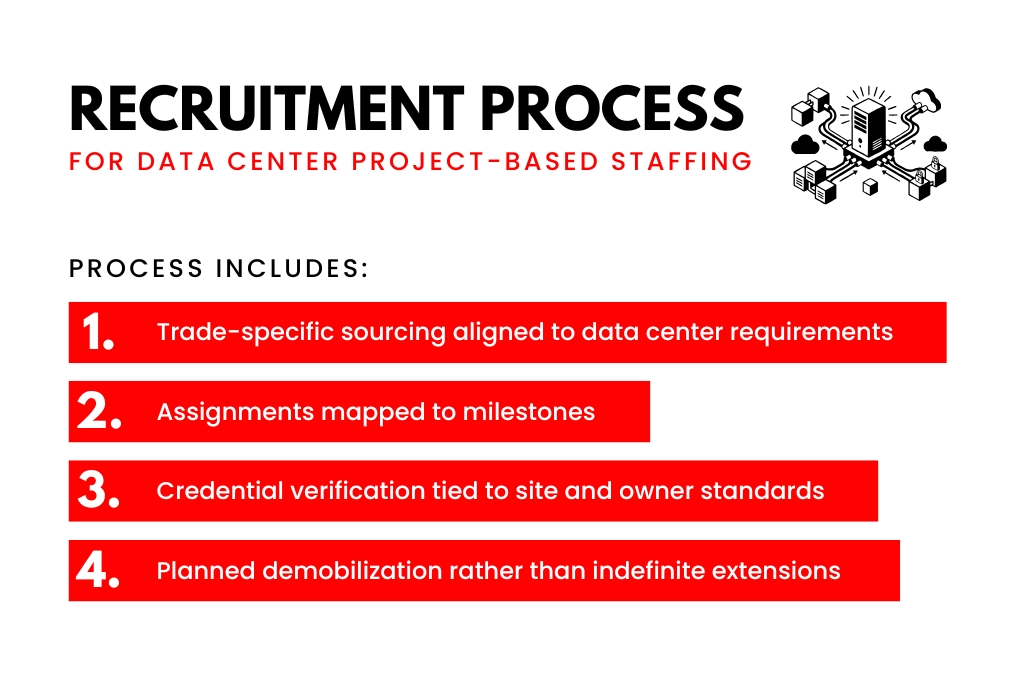
This approach typically includes:
- Trade-specific sourcing aligned to data center requirements
- Assignments mapped to milestones such as energization or commissioning
- Credential verification tied to site and owner standards
- Planned demobilization rather than indefinite extensions
This is not interchangeable with generic temporary staffing. The distinction matters. Data center sites demand workers who can step into tightly coordinated environments without extended ramp-up.
Why Traditional Construction Hiring Models are Breaking Down
Data Center Projects Demand Intense Labor, Then Almost None
Data center construction stays labor-intensive from civil work through commissioning, but that intensity is temporary. Headcount spikes for concrete, steel, electrical rough-in, mechanical installation, and then spikes again near turnover when testing and commissioning ramp up.
Once the site is delivered, most of that labor disappears overnight. The owner keeps a lean operations team, and the contractor moves on. That creates a structural mismatch for permanent hiring: companies carry payroll for work that no longer exists.
Project-based recruitment fits the reality better because it treats labor as a phase-driven requirement with a clear demobilization point, not a long-term staffing promise.
Phase Compression Leaves No Margin for Hiring Delays
Data center builds often compress multiple scopes into overlapping windows. Electrical rough-in, mechanical installation, and controls integration frequently run in parallel to meet owner delivery targets.
When labor arrives late or lacks readiness, downstream work stalls. Commissioning windows slip. Owners escalate.
Project-based recruitment addresses this by aligning hiring timelines to construction logic rather than headcount forecasts.
Skilled Trade Shortages are More Acute in Data Center Work
The construction industry continues to face broad labor shortages, particularly in skilled trades. Data center projects feel this more sharply because they compete for electricians, HVAC technicians, and system specialists who already command premium demand.
According to workforce analyses, labor availability has not kept pace with the growth in data center and infrastructure projects. It is estimated that around 500,000 new trade workers are needed in order to meet the current project demands.
In practice, this leads to a narrower hiring window. Project-based recruitment works within that reality by targeting workers with relevant data center experience rather than relying on general trade pools.
Fixed Labor Costs Create Unnecessary Exposure
Permanent hiring makes sense for project leadership and long-term operations. It introduces risk when applied to phase-dependent scopes.
Aligning labor cost with construction progress reduces exposure during delays, scope changes, or permitting issues. For contractors operating on thin margins, this alignment can be the difference between protecting profitability and absorbing losses.
Clearing Up Common Misunderstandings
Project-Based Recruitment Is Not Lower Quality Labor
Quality issues arise when workers are mismatched to scope, not when they are hired on contract. Data center projects reward specialization. Workers who have installed similar systems under similar constraints often outperform less experienced permanent hires.
It Is Not a Short-Term Fix
Firms that treat project-based recruitment as a last-minute solution tend to struggle. Those that integrate it into workforce planning earlier gain consistency. The difference is timing, not intent.
How Hiring Managers Can Apply Project-Based Recruitment Effectively
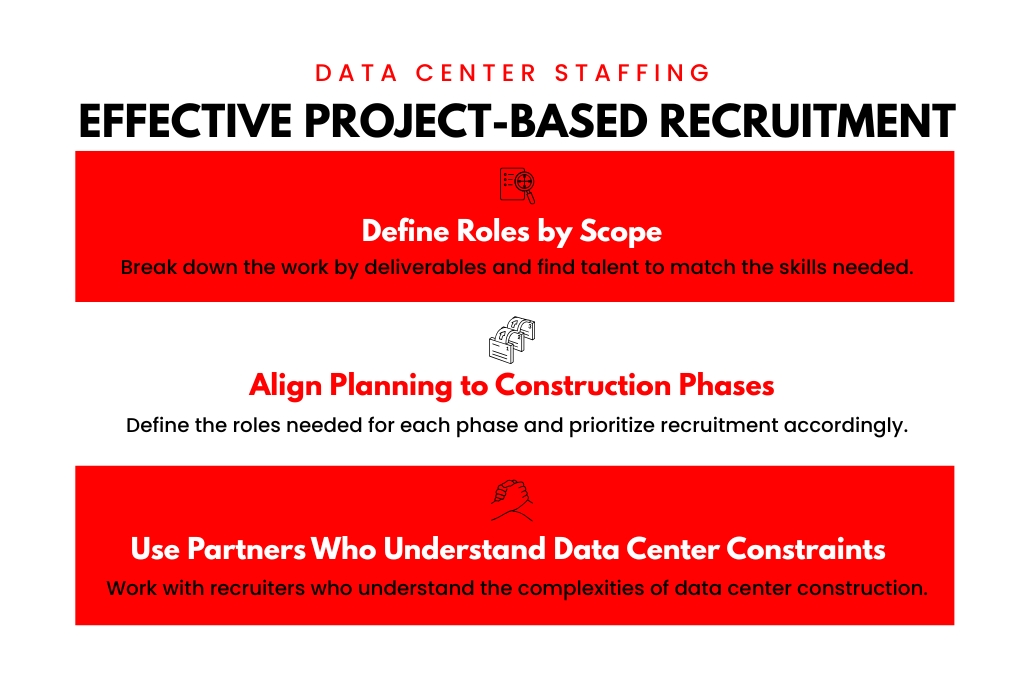
Start With Scope, Not Job Titles
Effective recruiting begins with scope definition. Hiring managers who break work down by deliverable rather than role title see better results.
Electrical commissioning technicians, for example, require different experience than general electricians. Treating them as interchangeable slows progress later.
Align Workforce Planning to Construction Phases
A phase-based plan reduces overstaffing and shortages:
- Early site work and structural phases
- Core electrical and mechanical installation
- Controls integration and commissioning
- Testing and turnover
Each phase carries distinct labor needs. Recruiting should follow that sequence.
Use Partners Who Understand Data Center Constraints
Generic construction recruiters struggle with data center projects because they underestimate documentation, safety, and owner requirements. Specialized partners reduce friction by delivering workers who meet site standards before arrival.
Focus Areas of the Recruitment Process
Commissioning Is the True Labor Bottleneck
Most staffing discussions focus on early construction. Commissioning is where labor shortages cause the most disruption. Specialized technicians are limited, timelines are tight, and errors are costly.
Project-based recruitment that prioritizes late-stage technical roles reduces last-minute scrambling and owner conflict.
Regional Labor Compression Is Intensifying
Virginia and Texas face a specific challenge. Data center growth is concentrated geographically, creating competition among projects for the same labor pools. Firms that rely solely on national sourcing often lose time to relocation delays and cost premiums.
Local labor networks, apprenticeship relationships, and regional recruiters are becoming strategic assets, not optional channels.
Integrating Project-Based Recruitment into a Long-Term Strategy
Project-based recruitment works best alongside a stable internal core:
- Permanent project managers and safety leadership
- Contract-based skilled trades aligned to phases
- Long-term relationships with training programs and trade schools
This structure balances continuity with flexibility and reflects how data center construction operates.
Closing Perspective
Project-based recruitment is gaining traction because it mirrors the realities of data center construction. Tight schedules, specialized scopes, and regional labor pressure leave little room for static hiring models.
For construction hiring managers and builders working in Virginia and Texas, the question is no longer whether to use project-based recruitment, but how deliberately it is applied. Firms that treat it as a planning discipline rather than a staffing shortcut are better positioned to deliver on time, protect margins, and meet owner expectations.
PeopleSolutions works with construction teams that need this level of alignment, not volume hiring. The difference shows up on site, not in job descriptions.
For more information relating to data center contract staffing, reach out to our team of experts.