
Data center growth is changing compensation expectations in the industries tied to the projects. Even if workers aren’t involved directly with data center projects, their compensation expectations may be influenced by peers that are.
The strongest public evidence tells us that pay is moving fastest in roles closest to infrastructure reliability, including network architecture, systems administration, electrical work, cooling, controls, and critical-facilities engineering. Once those roles start paying more, candidates in overlapping labor pools begin using those offers to judge what their own skills should be worth elsewhere.
Table of Contents
Why Data Center Projects Affect Pay Beyond Data Center Construction
The spillover starts with labor market overlap. Data center operators don’t recruit from a sealed ecosystem. They hire many of the same people that manufacturers, utilities, healthcare systems, industrial plants, engineering firms, and enterprise IT departments need: network architects, systems administrators, electricians, HVAC and mechanical technicians, controls specialists, facilities engineers, and reliability-focused operations talent. When one part of the market can pay materially more for those same capabilities, it raises the outside option for the worker, even if that worker never accepts a data center project offer.
Pressure shows up in pay expectations before it fully rewrites salary bands. A candidate doesn’t need a long data center résumé to see what the market is paying for electrical, mechanical, or controls work in critical environments.
Google is currently advertising electrical, mechanical, and controls facilities technician roles at base salaries of $95,000 to $134,000, plus bonus, equity, and benefits. Once workers start seeing packages like that, employers in other sectors are no longer competing against their own historic pay logic. They are competing against the most attractive alternative a candidate can credibly imagine.
Data Center Compensation vs Industry Compensation
Public wage data doesn’t neatly label every employer as a “data center operator,” but it does group together companies whose core business is providing computing infrastructure, data processing, web hosting, cloud storage, colocation, and related services. This is where the data center roles fit into the equation.
In May 2023, computer network architects working in computing infrastructure, data processing, web hosting, and related services averaged $143,310 a year, compared with $140,550 in the main portion of the industry. Network and computer systems administrators averaged $109,900 versus $103,040. Electricians averaged $73,550 in the computing-infrastructure segment versus $66,980 in specialty trade contractors. These comparisons show that the same skill set often pays more when it is embedded in infrastructure-intensive, uptime-critical environments like data centers and cloud hosting operations.
The trade side of the data center work seems to pay an even higher premium. Open roles for Google’s electrical facilities technician roles pay $95,000 to $134,000. BLS puts electricians in specialty trade contractors at $66,980 in May 2023. HVAC mechanics and installers average $58,490.
As you can see, Google’s pay range sits far above the broader contractor-side benchmarks for comparable electrical, mechanical, and controls work. Operators are paying a clear premium for trade talent once the role includes uptime risk, redundancy, and critical-systems responsibility.
The mechanical engineering side follows the same logic. Equinix lists a principal mechanical engineer role at $136,000 to $204,000 in Dallas and $150,000 to $224,000 in Ashburn and New York City. By contrast, BLS reports a 2024 median annual wage of $102,320 for mechanical engineers overall. This wage gap shows that the market values mechanical expertise differently when it is tied to cooling architecture, reliability, capacity optimization, and continuous operations instead of more general design work.
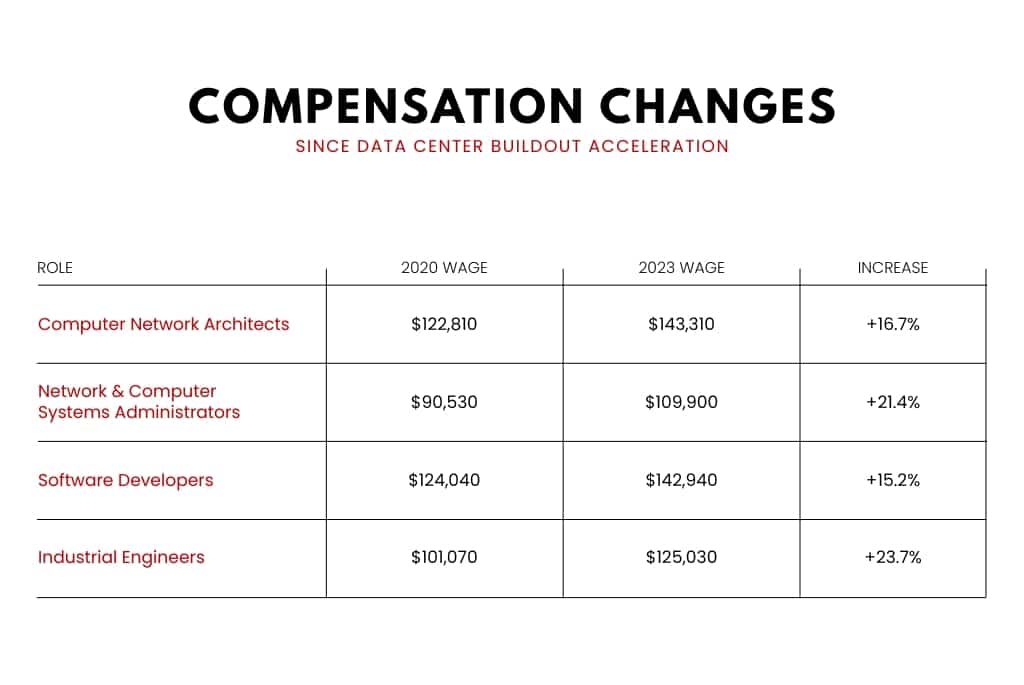
How Much Pay Has Increased Since Data Center Buildouts Accelerated
The recent wage growth in data-center-adjacent industries is large enough to matter. In BLS data for data processing, hosting, and related services, computer network architects rose from $122,810 in 2020 to $143,310 in 2023, an increase of about 16.7%.
Network and computer systems administrators rose from $90,530 to $109,900, about 21.4%.
In the same industry grouping, software developers rose from $124,040 in 2021 to $142,940 in 2023, about 15.2%, and industrial engineers rose from $101,070 to $125,030, about 23.7%. Those are not minor year-to-year adjustments. They’re meaningful increases in roles that sit close to digital infrastructure and operational reliability.
The timing lines up with an extraordinary build cycle. CBRE reported that North American supply under construction reached 6,350.1 MW in 2024, up from 456.8 MW in 2020, while total supply in primary markets rose 34% year over year.
There are many other factors that could potentially be impacting these substantial pay gains: cloud demand, AI spending, inflation, power constraints, and broader shortages of specialized labor are all relevant.
But the pattern is still hard to dismiss: the occupations most exposed to data center growth also saw substantial pay gains during the same period.
Why Manufacturing, Engineering, And Enterprise IT Feel the Most Pressure
The pressure doesn’t spread evenly because the overlap isn’t evenly distributed. A general production supervisor is not affected the same way as a controls technician. A generic mechanical design role is not affected the same way as a mechanical engineer working on cooling, water treatment, airflow, redundancy, or critical-facility optimization. A broad IT support role is not affected the same way as a network architect or systems administrator responsible for high-availability infrastructure. The closer a role sits to uptime, power, cooling, monitoring, and failure prevention, the more portable it becomes into data center work and the more exposed it becomes to data center pay ranges.
That’s why the spillover often shows up as benchmarking pressure instead of pure attrition. A manufacturer may not lose every electrical or controls candidate to a data center operator. It may simply find that its compensation no longer looks competitive to candidates who know what critical-environment work pays. That changes negotiations, offer acceptance, retention risk, and eventually internal salary logic. Data center roles are making candidates question why they should stay in a role that’s technically similar but pays 15-25% less.
What Changes When Data Center Projects Slow Down
The first thing to soften is usually not base salary. It’s the project-driven layer on top of base salary: overtime-heavy earnings, travel pay, schedule-compression premiums, and urgency-driven bonuses. Those earnings are attached to delivery pressure. When a project starts to slow or construction schedules become less aggressive, employers can pull back on that layer faster than they can cut the core compensation needed to hire and keep specialized people.
The stickier part of the market is the pay attached to scarce infrastructure skills. Built capacity still has to operate after construction crews leave. Cooling systems still need to perform. Electrical systems still need to be maintained. Controls still need to be monitored and tuned. Networks still need to stay available. That’s why a slowdown in new builds should cool the most aggressive project premiums before it fully resets compensation expectations for power, cooling, controls, networking, and critical-facilities roles.
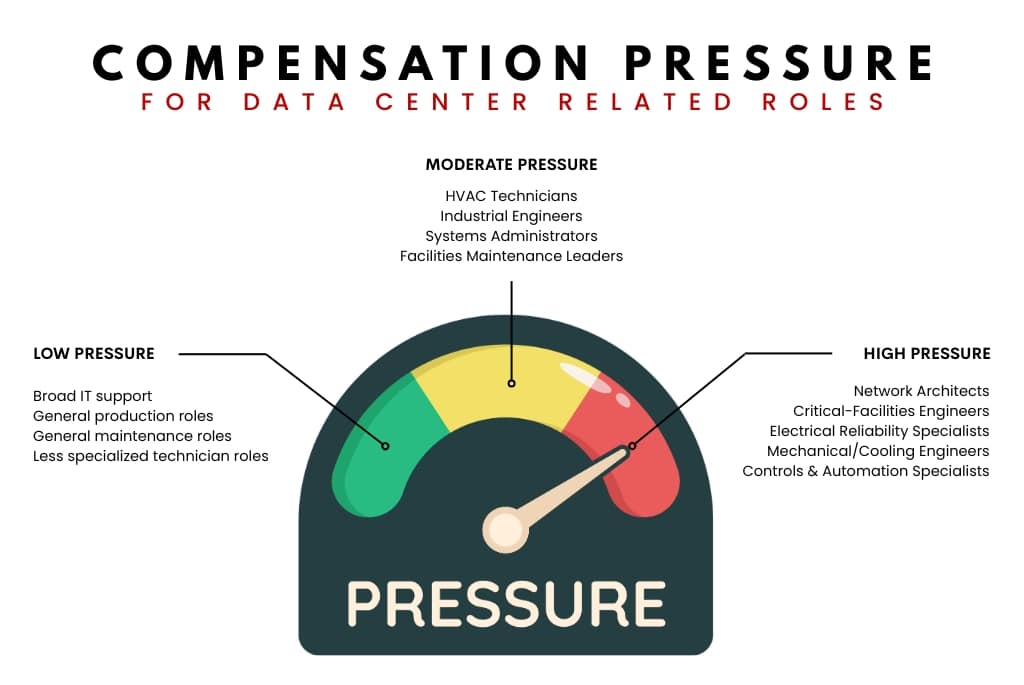
Which Expectations Are Most Likely to Stick
The expectations most likely to hold up are attached to skills that remain hard to replace even after the construction surge cools. That includes electrical reliability work, mechanical and cooling expertise in critical environments, controls and automation tied to facility uptime, network architecture, systems administration, and senior facilities engineering. These roles stay valuable because the consequence of failure is high and the candidate pool is limited. Even outside data centers, employers that depend on continuous operations face the same basic problem: they desperately need people who can prevent expensive downtime.
The expectations more likely to normalize are the ones created by exceptional project conditions rather than by durable scarcity. Roles that benefited mainly from temporary overtime, remote-location premiums, or unusually compressed schedules are more vulnerable if the pace of construction cools. The same is true for jobs with a broader local labor pool and less direct exposure to uptime-critical systems. Those jobs can still see spillover pressure, but they are less likely to keep a lasting premium once the market becomes less urgent.
What Employers Outside Data Centers Need to Understand
For employers hiring these roles outside the data center ecosystem, there’s no need to panic and raise pay across every technical title. Instead, identify where compensation is being distorted by real competition from digital infrastructure and where it’s not.
Employers in manufacturing, industrial services, utilities, and enterprise IT need to separate general technical hiring from hiring that overlaps with data center demand. You may not need to reprice every engineer, technician, or administrator on your team, but for the jobs tied to power, cooling, controls, networks, and facilities reliability, you likely need to address the wage gap that now exists.
Companies competing against data centers for specialized talent won’t always be able to match the pay ranges of these tech giants. In such cases, training and narrower career-path design become more important because buying the finished skill set may no longer be cheap enough to be the default answer.
FAQ
Do Data Center Jobs Really Pay More Than Similar Jobs in Other Industries?
In several cases, yes. BLS industry data shows higher average pay in the computing-infrastructure industry than in comparison industries for network architects, network and computer systems administrators, software developers, and electricians. Company postings suggest the premium can be much larger for electrical, mechanical, and controls roles when the job sits inside a critical data center environment.
Which Roles See the Clearest Data Center Premium?
The clearest public evidence points to network architecture, systems administration, electrical work, mechanical and cooling roles, controls, and critical-facilities engineering. The common factor is responsibility for uptime, redundancy, and high-consequence infrastructure.
Will Salaries Fall If Data Center Projects Slow Down?
Some compensation will cool first, especially overtime-heavy earnings and urgency-based project premiums. Base-pay expectations are more likely to stay elevated in scarce infrastructure roles because the work of operating and maintaining built capacity does not disappear when the construction cycle becomes less aggressive.
Why Are Manufacturers and Non-Data-Center Employers Affected?
Because many of them hire from the same labor pools. Once electrical, mechanical, controls, facilities, and infrastructure roles start paying more in data center environments, candidates in adjacent industries begin using those offers as a benchmark for their own value.
Conclusion
Data center growth is not rewriting every pay scale in engineering, manufacturing, and IT. It is however, doing something more targeted and more important. It’s attaching a visible premium to the skills closest to infrastructure reliability, then pushing those expectations outward into the industries that need the same people.
That’s why the effect is strongest in electrical, mechanical, controls, networking, and critical-facilities work. It is also why a slowdown in project activity is likely to reduce the most aggressive premiums without restoring the older, cheaper assumptions many employers still want to use.
If you’re looking for specialized staff in these industries and are struggling to compete against data center roles, start a conversation with our team. We can help you find a solution that brings you better results for your staffing efforts.