Leaders comparing staffing options often encounter two similar sounding terms: staff augmentation and temporary staffing. Both involve external workers. Both avoid permanent hires. Both appear to offer flexibility.
The biggest difference is not skill level, project duration, or hourly rates. It is who manages the worker. Understanding that distinction explains why companies sometimes struggle when they choose the wrong model and why certain projects succeed or fail depending on how outside talent is structured.
Table of Contents
TL;DR: Staff Augmentation vs Temporary Staffing: Quick Decision Guide
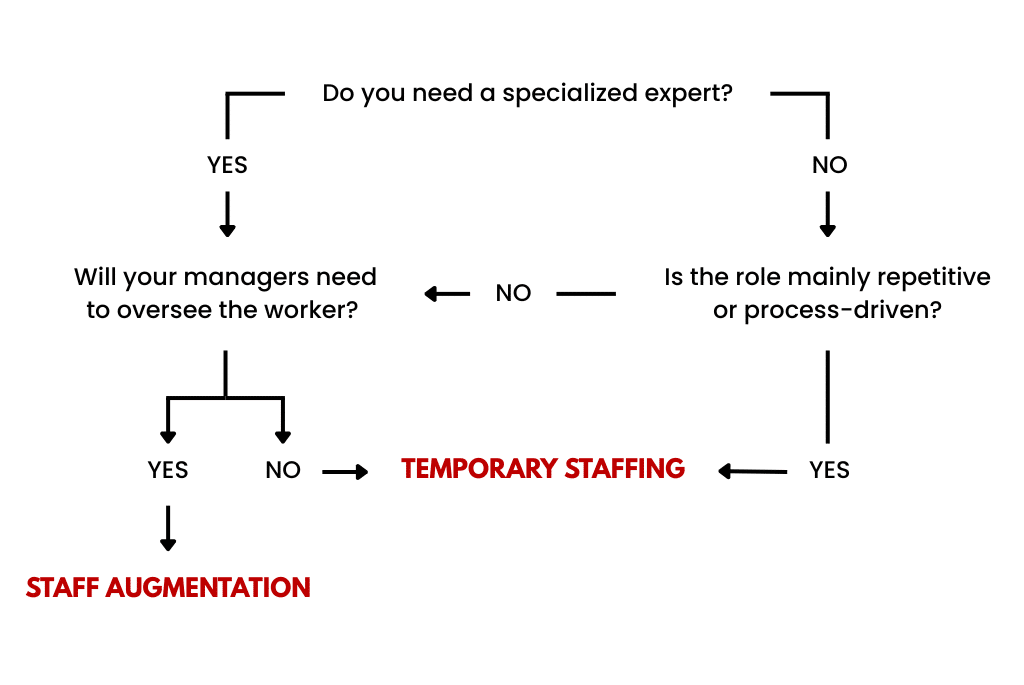
For organizations evaluating contract staffing models, the decision often comes down to one practical question: Who needs to manage the worker?
Choose staff augmentation when:
- Contractors must integrate into internal teams
- Managers need direct control over tasks and priorities
- The work requires specialized expertise
Choose temporary staffing when:
- Workers will perform clearly defined operational tasks
- The organization needs workers quickly
- Assignments are short and task-focused
Staff Augmentation vs Temporary Staffing Key Differences
| Factor | Staff Augmentation | Temporary Staffing |
| Worker management | Client company manages the work | Staffing agency coordinates employment |
| Worker integration | Embedded within internal teams | Performs defined operational tasks |
| Work structure | Project-based and collaborative | Task-based and operational |
| Assignment duration | Often months or project length | Days to months |
Companies comparing these models often focus on duration or hourly cost. In practice, management responsibility usually determines which model works.
What Is Staff Augmentation?
Staff augmentation (or staff aug) is a contract staffing model where outside professionals join an internal team and work under the company’s direct supervision. The organization manages the worker’s tasks, priorities, and workflow just as it would with its own employees.
The external professional provides specialized expertise. The company remains responsible for directing the work.
This structure makes staff augmentation common in environments where work is collaborative and evolving rather than a strictly defined process.
How Staff Augmentation Works
The process typically begins with a skill gap. Hiring permanent employees for specialized roles can take months. In many cases, the work itself may only last 6-12 months.
Instead, the company contracts experienced professionals who already possess the required skills. Those professionals integrate into the internal team. Managers assign tasks, review deliverables, and include the contractor in team discussions because their work affects the broader project.
From a workflow perspective, the contractor functions much like a temporary employee embedded inside the organization.
Typical Roles Hired Through Staff Augmentation
Staff augmentation usually supports specialized roles where expertise directly influences project outcomes.
Common examples include:
- Software developers
- Data engineers
- Cybersecurity specialists
- Mechanical or electrical engineers
- Technical project managers
These professionals often perform work that internal employees cannot easily absorb.
Advantages & Disadvantages of Staff Augmentation
| Advantages | Disadvantages |
| Access to specialized expertise without long hiring cycles | Higher hourly rates for experienced professionals |
| Internal managers maintain direct control over tasks and priorities | Requires internal leadership to manage the contractor effectively |
| Contractors integrate directly into internal teams and workflows | Onboarding may take longer because the worker must understand internal systems |
| Flexible way to scale project teams without adding permanent headcount | Not ideal for routine operational work |
What Is Temporary Staffing?
Temporary staffing provides workers to fill short-term roles where the responsibilities are already clearly defined. These workers typically support ongoing operations rather than collaborative projects.
The staffing agency recruits the workers, places them into assignments, and handles employment administration such as payroll and compliance. Companies receive workers who can step directly into established roles.
How Temporary Staffing Works
Temporary staffing works best when the work is predictable or has a defined process.
Consider a distribution center preparing for peak shipping season. Order volume may double for several weeks, but the tasks involved in picking, packing, and shipping orders remain the same.
The company doesn’t need additional expertise; it needs additional people.
A staffing agency recruits workers who can perform those tasks. Once placed, the workers follow existing procedures and workflows already established within the organization. Assignments often last days, weeks, or a few months.
Typical Roles Hired Through Temporary Staffing
Temporary staffing most commonly supports operational roles such as:
- Administrative assistants
- Warehouse associates
- Manufacturing operators
- Customer service representatives
- Retail sales staff
These roles usually involve repeatable tasks rather than complex project collaboration.
Advantages & Disadvantages of Temporary Staffing
| Advantages | Disadvantages |
| Quickly adds workers during demand spikes | Limited access to specialized expertise |
| Staffing agency handles recruiting, payroll, and employment administration | Workers typically stay for shorter periods |
| Lower hourly cost compared with specialized contractors | Less integration with internal teams |
| Works well for repeatable operational tasks | Less flexibility if the role needs to evolve |
Who Manages the Worker?
Management In Staff Augmentation
With staff augmentation, the company directs the contractor’s work. Project managers assign tasks. Team leaders review progress. Contractors participate in meetings because their work affects the broader team.
This structure gives the organization flexibility to adjust priorities as projects evolve but it also requires the company to provide consistent supervision.
Management In Temporary Staffing
Temporary staffing places workers into predefined roles. The company still supervises day-to-day activity, but the work itself is already structured. Workers follow established procedures rather than contributing to evolving project decisions.
For example, a manufacturing facility hiring temporary assembly workers already has defined production processes. The temporary workers support those processes rather than helping design them.
Cost Differences: Staff Augmentation vs Temporary Staffing
Cost Structure of Staff Augmentation
Staff augmentation contractors command higher hourly rates because they bring specialized expertise. However, companies still avoid long-term costs associated with full-time employment like employee benefits.
According to the U.S. Bureau of Labor Statistics, benefits account for roughly 30% of total compensation costs for private-sector workers.
For project-based work, contracting specialists can sometimes cost less than hiring permanent employees who may not be needed after the project ends.
Cost Structure of Temporary Staffing
Temporary staffing generally involves lower hourly pay because roles focus on operational work rather than specialized expertise.
Costs typically include the worker’s wages and the staffing agency’s service fee. The agency handles employment administration, reducing the company’s recruiting workload.
For businesses dealing with fluctuating demand, this structure provides a predictable and scalable labor cost model.
When Each Model Works Best
Choosing the right staffing model depends on the type of work and how it must be managed.
When Staff Augmentation Is the Better Fit
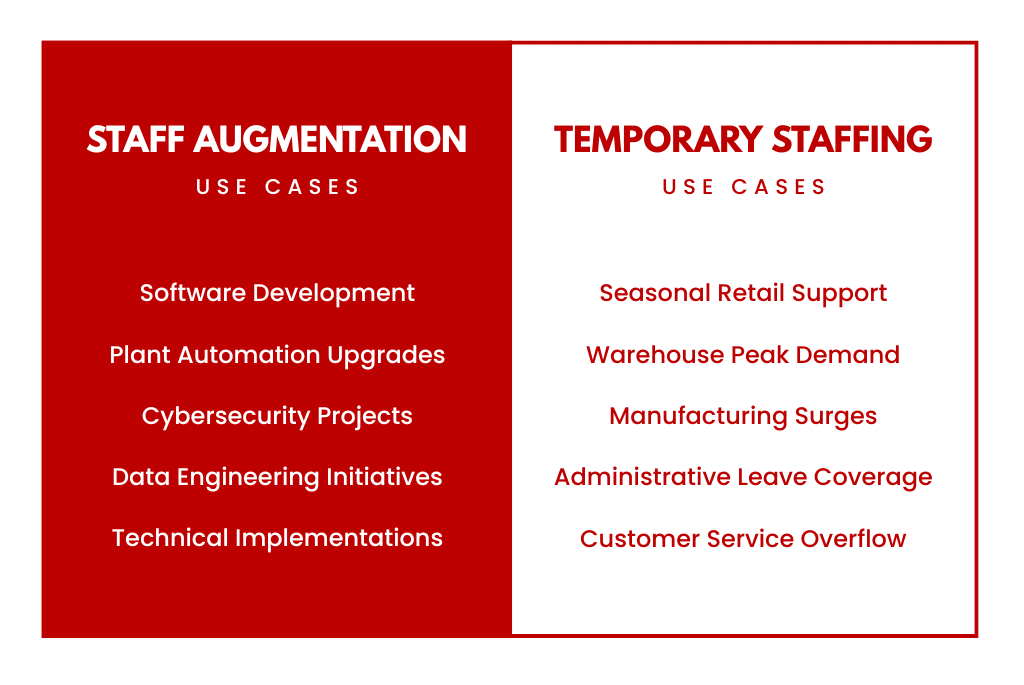
Staff augmentation works best when outside professionals must collaborate closely with internal teams.
Common situations include:
- Software development projects
- Engineering initiatives such as plant automation upgrades
- Data or cybersecurity programs
- Complex technology implementations
These environments require direct oversight and ongoing collaboration.
When Temporary Staffing Is the Better Fit
Temporary staffing is most effective when organizations need additional workers to perform clearly defined tasks.
Typical situations include:
- Seasonal retail hiring
- Warehouse demand spikes
- Administrative coverage during employee leave
- Manufacturing production surges
The work already exists. The organization simply needs more people to perform it.
Why Workforce Strategies Are Becoming More Flexible
Many companies now combine multiple hiring models rather than relying on just one.
Permanent employees provide institutional knowledge and leadership. Staff augmentation supports specialized project work. Temporary staffing allows organizations to respond quickly to operational demand.
Organizations that understand how these models differ operationally are better positioned to use them effectively.
PeopleSolutions regularly publishes research and guidance on workforce planning strategies for organizations navigating these decisions. For more information or to discuss your staffing strategies, reach out to our team!