TL; DR
A statement of work (or SOW) works best when the company needs a provider to own a defined result with clear deliverables, milestones, and acceptance criteria.
Project-based staffing works best when the company needs specialized contract talent for a defined initiative but wants to keep day-to-day control of the work internally.
The deciding factor usually isn’t price or speed alone. It’s whether the work is clear enough to scope, stable enough to formalize, and supported by internal leadership that can manage it well. If the company can’t define success, assign ownership, or track progress, either model can turn into drift, rework, and unnecessary spending.
So how can you structure the work so that you can hire efficiently and yet maintain control?
That’s where the choice between a statement of work and project-based staffing starts to matter. On the surface, both look like ways to get specialized help for a defined need but they’re not interchangeable.
One is built around a contracted result. The other is built around access to talent. Confusing those two ideas causes a lot of avoidable trouble.
Table of Contents
What Is a Statement of Work (SOW)?
A statement of work, often shortened to SOW, is a formal document that defines what a provider is expected to deliver under a contract.
In practical terms, a SOW is used when a company wants to buy a defined result rather than simply rent capacity. That result might be a software implementation, a compliance audit, a site migration, or a reporting build with named milestones. The provider is expected to deliver against a documented scope, timeline, and acceptance standard.
That point matters because many teams hear “SOW” and assume it means the company no longer has to manage the work. This is not the case. A SOW changes the structure of accountability, but it doesn’t eliminate the need for oversight. Someone still has to approve milestones, resolve scope questions, and decide whether the delivered work meets the agreed standard. A SOW reduces ambiguity only when the scope has been thought through well enough to support it.
What Is Project-Based Staffing?
Project-based staffing is a staffing approach used to bring in contract talent for a specific initiative, deadline, or skill gap. The assignment has a defined purpose, but the company usually retains more day-to-day control over how the work gets done.
If a company hires a contract data engineer for a six-month system cleanup, the company is still managing priorities, workflow, and delivery. It’s buying expertise for a project but not outsourcing the outcome of the project itself.
Project-based staffing works best when the company needs speed, knows the capability gap, and has someone internally who can steer the work without turning every decision into a committee discussion.
This model has become more common because project work keeps expanding and specialized skill shortages have not gone away. PMI says there are about 39.6 million project professionals worldwide in 2025, and demand could rise to 65.4 million by 2035.
The Biggest Difference Between Statement of Work (SOW) vs Project-Based Staffing
The main difference comes down to what the company is buying and who carries delivery responsibility.
A statement of work is usually the better fit when the company wants a provider to own a defined piece of work and be measured against agreed deliverables. Project-based staffing is usually the better fit when the company wants specialist talent to join an existing effort that internal leaders will still direct.
With a SOW, the company spends more time up front defining the work. With project-based staffing, the company spends more time during execution managing the work.
One front-loads structure. The other front-loads flexibility.
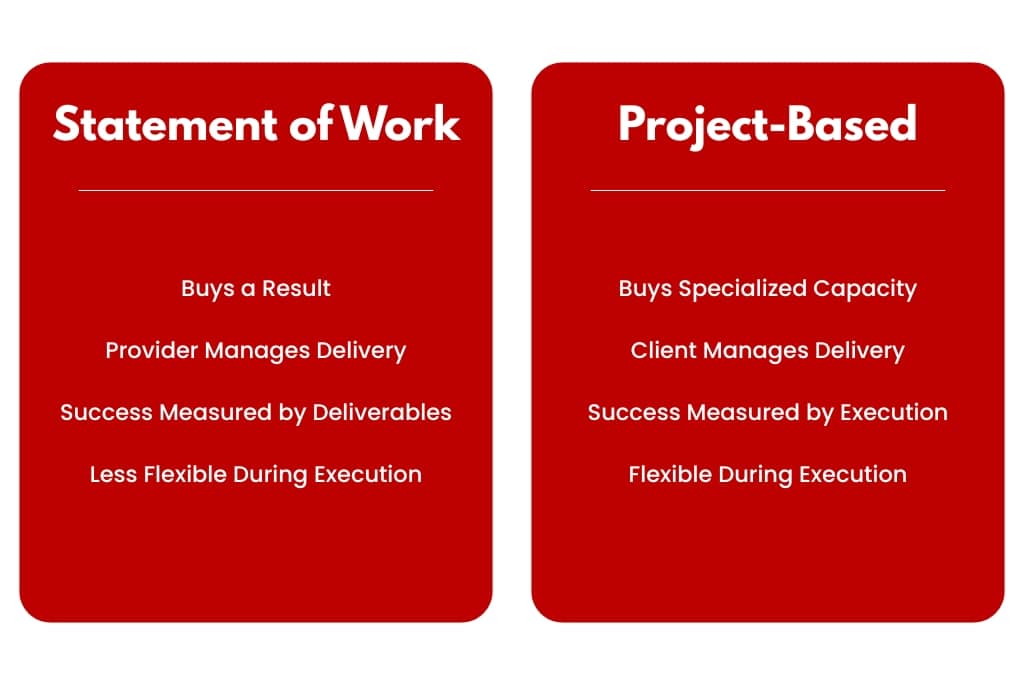
Statement of Work (SOW) vs Project-Based Staffing Comparison Chart
| Category | Statement Of Work (SOW) | Project-Based Staffing |
| Primary purpose | Buy a defined deliverable or business outcome | Add contract talent for a specific project or capability gap |
| Who manages the day-to-day work | Usually the provider | Usually the hiring company |
| Accountability for results | More contractually tied to the provider | More operationally tied to the client team |
| Scope definition | Typically detailed before work starts | Often narrower at the start and adjusted during the project |
| Pricing model | Often fixed fee, milestone-based, or outcome-based | Often hourly, daily, weekly, or term-based |
| Flexibility after kickoff | Lower unless the contract is modified | Higher because priorities can be redirected internally |
| Best fit | Stable work with clear deliverables and measurable acceptance criteria | Evolving work that needs specialist support and close internal direction |
| Main risk | Weak scoping creates disputes, change orders, and blurred acceptance standards | Weak internal management creates drift, rework, and cost creep |
Why Governance Matters More Than Labeling
The success or failure of either model usually depends less on the label and more on the company’s management discipline.
Deloitte’s 2024 Global Workforce Management survey found that 58% of organizations do not have a strategic governance structure for workforce management. The same report says 51% are not effectively using workforce data or analytics, despite better analytics generating savings of 0.5% to 2.5% of annual payroll spend. These governance structures affect how companies choose vendors, monitor performance, and spot overspend before it becomes a budget problem.
A lack of governance has direct consequences for both models. A SOW only works when the company can define the work clearly enough to hold the provider accountable. Project-based staffing only works when the company has the internal bandwidth to direct the work well. Without those conditions, the contract structure becomes a costume. The underlying management problem stays put.
Here’s a simple way to compare the options:
- If the work can be described in milestones and tested against acceptance criteria, SOW starts to make sense.
- If the work will change as the project unfolds and the company wants direct control over priorities, project-based staffing often makes more sense.
- If neither condition is true, the project is probably not ready to buy yet.
When Statement of Work (SOW) Is the Better Fit
SOW tends to perform best when the work has clear boundaries, meaningful risk, and a result that can be accepted or rejected against an agreed standard. Acquisition.gov’s work statement guidance is useful here because it stresses clarity, completeness, and tailoring the statement to the objective. This is what creates the basis of enforceable accountability.
This makes SOW a strong fit for work such as implementations, compliance programs, specialized consulting engagements, managed service components, and defined transformation projects. In each case, the company is asking for a completed project, not someone who can work on the project.
The deeper advantage of SOW is often missed. SOW forces the company to make decisions earlier.
What exactly is in scope? What counts as done? Who signs off? Those questions can feel tedious in the beginning, but they ensure alignment on a project from the very start. This reduces expensive changes that can happen halfway through the project when people realize they were never on the same page.
When Project-Based Staffing Is the Better Fit
Project-based staffing is usually stronger when speed matters, scope of work may shift, and the company already knows how it wants to direct the work. In those cases, bringing in the right specialist can be faster and more efficient than building a full provider-led engagement.
This model is especially useful when the need is narrow and time bound. A marketing team may need a paid media specialist for a product launch. An operations group may need an ERP analyst during a rollout. A life sciences firm may need a validation consultant for a compressed project window. The internal team owns the project. The contractor strengthens execution.
The risk is that project-based staffing assumes the client can manage the work. If the manager is overloaded, priorities are unclear, or the work touches multiple functions with no real owner, the contractor ends up absorbing the ambiguity. Hours rise. Decisions stall. The project starts to wobble even when the talent itself is strong.
Where Companies Usually Get into Trouble
The trouble rarely starts with the labor model. It starts with weak information and vague ownership.
Many staffing and procurement problems are really operating model problems. A company may think it needs faster vendors when it actually needs a better scope from the project owner. Or clearer acceptance standards. Or cleaner reporting. Or someone empowered to say no when the project starts swallowing extra work for free.
The second issue is timing. SOW asks for more clarity before kickoff. Project-based staffing tolerates more uncertainty at the start but demands stronger management during the work. The choice is partly about risk placement. A company has to decide whether it wants to do more thinking upfront or more directing during execution. There’s no way around that tradeoff.
How To Choose the Right Model
The decision gets simpler when it is tied to operating conditions instead of preference.
Choose statement of work (SOW) when the deliverable is clear, the risk is meaningful, and the company wants the provider to carry more explicit responsibility for the result.
Choose project-based staffing when the company needs specialized talent quickly, expects priorities to evolve, and has an internal leader who can manage the work closely.
Pause before choosing either model if the scope is still speculative, ownership is split across teams, or no one can explain how success will be measured. That’s usually a signal that the project needs sharper internal definition before outside help is added.
The strongest staffing partner is not the one that forces every problem into the same engagement model. It is the one that can tell the difference between a resourcing gap and a scoping problem.
How PeopleSolutions Fits the Decision
If you’re still not sure which hiring model is right for your next project, reach out to our team to get a clearer answer for your unique situation. Our contract staffing specialists have expertise and experience with various contract staffing models across a variety of industries and situations. Whatever your needs are for your next project, PeopleSolutions is here to help you find the staffing solution that gets you the results you need.